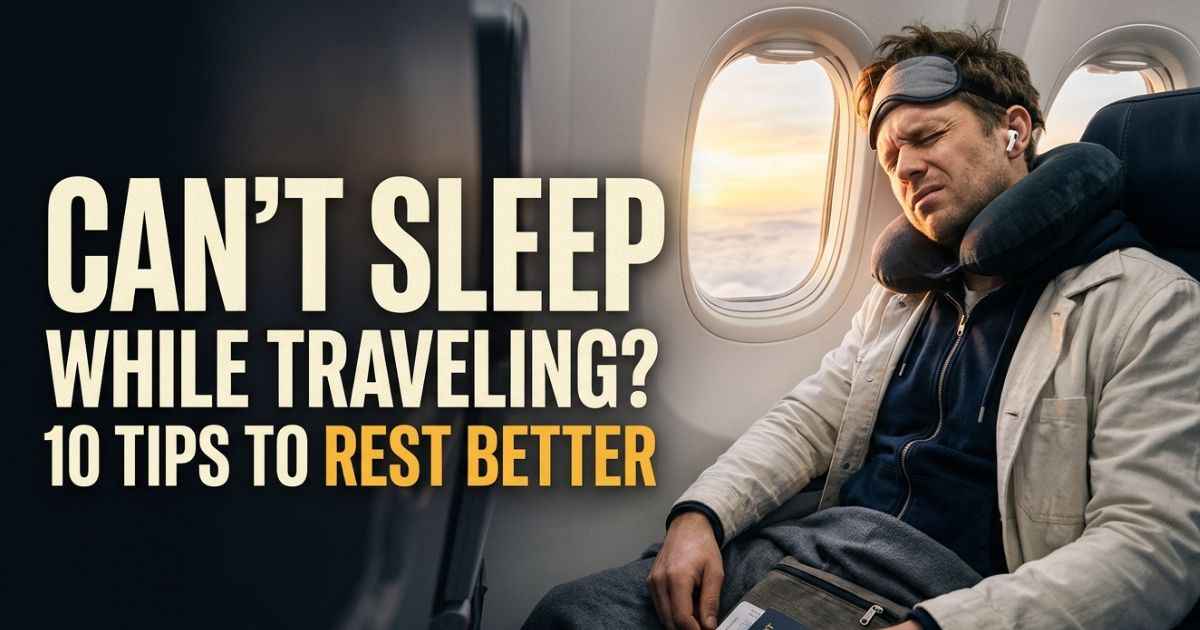
Good travel sleep tips start before you leave and last until you are home. Shift your bedtime a little before a big time change. Pack an eye mask and earplugs. Make your hotel room dark and quiet. Then follow the local schedule when you land. Travel can hurt your sleep in three ways: time zones, bad seats, and strange beds. This guide helps with all three.
Travel Sleep Tips: 10 Ways to Get Better Rest
Use this list as a quick guide. The sections below explain each step.
- Start moving your bedtime a few days before a long trip across time zones.
- Pack a small sleep kit.
- Limit alcohol and caffeine near bedtime.
- Make your room dark and quiet.
- Follow the local schedule when it makes sense.
- Keep any nap short.
- Use a bedtime routine you know.
- Pick a seat that fits how you sleep.
- Rest quietly if sleep will not come.
- Ask a health care provider before you use melatonin or sleeping pills.
What a small sleep kit holds
Pack these items in one pouch so you do not have to hunt for them:
- An eye mask to block light
- Earplugs, or noise-canceling headphones on a plane
- A neck pillow
- Soft, loose layers
- A water bottle
Sleep Foundation also lists hydration as part of in-flight comfort. You do not need fancy brands. The basics do the job.
Why You Sleep Badly When You Travel
Not every bad night away from home is jet lag. It helps to know which problem you have.
Travel fatigue is temporary exhaustion from a journey. It can happen without crossing time zones. Cramped seats, long journeys, and travel delays can contribute.
Jet lag happens when your body clock does not match the time at your destination. Mayo Clinic says it can happen after you cross two or more time zones.
The first-night effect is when you sleep poorly in a new place on the first night. Sleep Foundation says this can happen even when the room looks comfortable.
Each problem has a different fix. That is why one tip rarely works for every trip.
How to Adjust Your Sleep Schedule Before Travel
If you will cross time zones, start shifting early. The CDC says you can move your sleep by about one hour a day. Do this for two to three days before you leave. Johns Hopkins suggests starting three days before.
Both sources agree on the main idea. Move in small steps, not all at once.
| Direction | What to do before you leave |
|---|---|
| Flying east | Go to bed and wake up a little earlier each day |
| Flying west | Go to bed and wake up a little later each day |
Mayo Clinic says eastward trips can be harder. You have to fall asleep earlier than your body wants to.
Arrive well rested
Mayo Clinic also says lost sleep before a trip can make jet lag worse. Try to sleep well the nights before you go. A packing marathon the night before a flight works against you.
Should you adjust for a short trip?
Not always. Johns Hopkins says that on a trip shorter than two days, your normal schedule may make more sense. You will be home before your body clock can catch up. Treat this as a guide, not a hard rule for everyone.
How to Sleep on a Plane in Economy Class
Sleeping upright is hard. Some travelers still manage it with a few smart steps.
Pick a seat that fits you
Qantas says a window or aisle seat depends on what you need. No seat is best for everyone.
- A window seat lets you lean on the wall. One traveler on Reddit said the window helped hold their head still.
- An aisle seat helps if you need to get up often.
Use a neck pillow that holds your head
A good pillow does more than sit around your neck. It should keep your head from rolling.
Cover your eyes and ears
Sleep Foundation lists eye masks, earplugs, and noise-canceling headphones for planes. They cut down on cabin light and noise.
Wear soft layers
Plane cabins can feel cold. Soft, loose clothes and an extra layer keep you comfortable.
Plan your food and drinks
Qantas says to watch what you eat and drink before a flight. Skyscanner agrees. Alcohol can make sleep worse, according to the CDC. Eat and drink before the time you plan to sleep, so you are not interrupted.
Skip the seat belt trick
The Washington Post warns travelers to leave the seat belt hack to TikTokers. Do not copy that trend.
Plan around the time at your destination
Sleeping through the whole flight is not always best. If you sleep during daytime at your destination, you may find it harder to adjust. Think about when it will be night where you are going.
What to do when your head keeps falling forward
One traveler on Reddit described this as “head drops.” They kept getting “shocked awake.” Others said to lean on the window. In a separate Reddit discussion, another traveler described a sleep mask with straps attached to the airplane headrest. This is one traveler’s experience, not proven product performance.
Try these steps:
- Add head support, not just neck support.
- Wear an eye mask so the light does not wake you.
- Lean on the window if you have that seat.
What to do when you cannot sleep at all
Some people cannot sleep in economy, even with great gear. One Reddit traveler on a 14-hour flight planned a fan, pillow, mask, blanket, and headphones. They still worried about sleeping, and melatonin did not work for them.
One reply gave a calm answer. Accept that sleep might not happen. Rest with your eyes closed instead. Stressing about sleep can make it harder to relax.
How to Set Up a Hotel Room for Better Sleep
A new room can feel strange, so take a few minutes to set it up.
Ask for a quiet room
Sleep Foundation says to ask for a higher room. Ask for one away from elevators, lobbies, and conference rooms. These spots can be noisy.
Check the light
The CDC says a good sleep room is quiet, dark, comfortable, and cool. Block light around windows and doors. The CDC also mentions using clothes pins to keep curtains closed when you sleep away from home.
Check the temperature and bed
Test the room temperature before you settle in. Look at the mattress and pillows too. If something is wrong, tell the front desk early.
Bring something familiar
Sleep Foundation says to bring your own pillow or another familiar item from home. A photo or familiar scent may also make your hotel room feel more comfortable. Earplugs and white noise can also help with loud sounds.
Know when to ask for a new room
Sleep Foundation says a room change may be worth asking for if the room itself keeps you awake. Do not wait until the next day.
Keep your normal routine
Do what you do at home. Wash up, read, or sit quietly. The CDC says to avoid alcohol two to three hours before bed. It also says to avoid heavy or spicy meals in that window. Limit backlit screens before bedtime too.
Travel Sleep Tips for Hostels and Shared Rooms
Shared rooms bring a different problem. Other people’s noise is hard to control.
When your roommate snores
Earplugs do not always work. One solo traveler on Reddit said earplugs “barely do anything.” Another traveler used Loop earplugs and still had a bad night with a snoring roommate and a very hard bed. They booked a hotel for the next night.
Try more than one fix
White noise helped one traveler, but they had to turn it up a lot. Use these in combination:
- Earplugs plus an eye mask
- White noise at a level that covers the snoring
- A smaller dorm room, which came up in traveler talk about snoring
When a private room is worth it
Travelers in the discussions suggested paying more for a quieter room. If you are a light sleeper, a private room or hotel night may be worth the cost. This is especially true after a very long journey.
How to Manage Jet Lag After International Travel
Jet lag is a body clock problem. The CDC explains that it comes from a mismatch between your body’s normal rhythms and the time at your destination.
Follow the local schedule
Johns Hopkins says to follow the local flow, usually. Go to bed and eat meals at local times. Mayo Clinic agrees that local meal times can help.
Use light at the right time
Light can move your body clock. The CDC says morning and evening light shift it in different directions. The right timing depends on which way you fly and how many time zones you cross.
So “get sun right away” is not perfect advice for every trip. Mayo Clinic says travelers who cross more than eight time zones may need different light timing. After eastward travel, they may need to avoid morning light.
Move your body
Johns Hopkins says activity and time outside can help tell your body that the day has started.
Keep naps short
Nap advice is not the same from every source. Here is what each one says:
| Source | Nap advice |
|---|---|
| CDC Yellow Book | Avoid long daytime naps. Naps of about 20 to 30 minutes can help you stay alert. |
| CDC Travelers’ Health | Keep naps to about 15 to 20 minutes if you need them. |
| NHS | Do not sleep during the day. |
The CDC sources agree on the main point. Long naps can hurt your night sleep, but a short nap is fine for alertness. The NHS review date of May 31, 2026, has passed, so this guide leans on the newer CDC advice.
How long does jet lag last?
Mayo Clinic says recovery usually takes a few days. It gives a general estimate of about one day for each time zone you cross. Use that as a rough guide, not a promise.
Mayo Clinic also says jet lag can raise the risk of accidents caused by drowsy driving. Take extra care if you plan to drive after you arrive.
Should You Use Melatonin or Sleeping Pills for Travel?
Melatonin is a hormone supplement that people take to help sleep. It is not a sure fix.
Timing matters
The CDC warns that melatonin taken at the wrong time can make your body clock worse. Johns Hopkins says melatonin is not a full answer to jet lag. The NHS does not recommend it for jet lag. One Reddit traveler said it did not work for them.
More is not better
The CDC says 0.5 to 1 mg is often sufficient to shift your body clock. Taking melatonin at the wrong time can make the mismatch worse. The CDC also says the amount in a supplement can differ from what the label says. That is because melatonin is not regulated as a drug by the FDA.
Sleeping pills on flights
Johns Hopkins says some sleep medicines sold without a prescription can leave you groggy the next day. It also warns about mixing sedating medicines with anti-anxiety medicines used for flying. The CDC says long-acting sedative medicines can cause problems.
Some people on Reddit suggested pills, alcohol, or both. Do not copy that advice. Alcohol can make sleep and jet lag worse, according to the CDC.
Talk to a professional first
Cleveland Clinic says a health care provider can explain the benefits and risks of melatonin and other sleep aids. Ask before you travel, especially if you take other medicines.
What to Do When You Cannot Sleep While Traveling
Sometimes you do everything right and still cannot sleep. Here is how to handle it.
Take the pressure off
One traveler in Paris wrote, “I literally can’t sleep.” They had only two to three hours of sleep in 48 hours. They stayed awake after landing, but sleep still would not come at 2 a.m.
Replies suggested walking outdoors, eating a light dinner, and limiting alcohol. Another traveler suggested resting with closed eyes and avoiding phone use. These are ideas from travelers, not proven treatments. They line up with advice from the CDC and Sleep Foundation.
Rest quietly
If you cannot sleep, rest anyway. Lie still with your eyes closed. This is better than getting angry at yourself.
Return to your daytime routine
The next day, get back to local meal times, light, and activity. Keep any nap short. Do not expect to feel perfect right away.
Not every bad night is jet lag
One traveler in Japan had broken sleep for four days. They described a few broken hours each night, micro napping on trains, and trouble with basic tasks. Bad sleep can have other causes, such as a strange bed or travel stress.
When to get medical help
Cleveland Clinic says to contact a provider if symptoms last, get worse, or do not improve within about one week.
Current Checks
Health advice can change. Check these items before you rely on them.
| Item | What the research says now | Check again |
|---|---|---|
| Melatonin | CDC says 0.5 to 1 mg is often sufficient to shift your body clock. Taking melatonin at the wrong time can make the mismatch worse. | When the CDC Yellow Book updates |
| Sleep medicines | Johns Hopkins warns about next-day grogginess and mixing medicines | At least once a year |
| Nap length | CDC says 15 to 30 minutes, depending on the page | When the CDC updates |
| Light timing | Depends on travel direction and time zones | When the CDC updates |
| Jet lag recovery | Mayo Clinic says about one day per time zone | When Mayo Clinic updates |
Frequently Asked Questions About Travel Sleep Tips
How can I sleep comfortably on a long flight?
Pack an eye mask, earplugs, and a neck pillow. Wear soft layers. Pick a seat that fits how you sleep. If sleep does not come, rest with your eyes closed.
Is a window seat better for sleeping on a plane?
It depends on you. Qantas says a window or aisle seat depends on your needs. A window lets you lean on the wall. An aisle seat is easier if you need to get up.
Should I take a nap after arriving in a new time zone?
A short nap may help. The CDC says naps of about 20 to 30 minutes can help you stay alert. Long daytime naps can hurt your night sleep. The NHS says not to nap during the day.
How long does jet lag usually last?
Mayo Clinic says recovery usually takes a few days. A general estimate is about one day for each time zone you cross. Your own time may be different.
Can melatonin help with jet lag?
It might help some people, but timing matters. The CDC says the wrong timing can make things worse. Johns Hopkins says melatonin is not a full fix. Talk to a health care provider first.
How can I sleep when another person is snoring?
Try earplugs, an eye mask, and white noise together. Earplugs alone did not work for one traveler. A smaller dorm or a private room may also help.
Why do I wake up at 3 a.m. after international travel?
Your body clock may not match local time yet. The research did not find a proven fix for this. Rest quietly, follow the local schedule the next day, and get medical advice if it lasts more than about a week.
How can I recover from jet lag after returning home?
Use the same steps you used when you arrived. Follow your home schedule, get daylight at the right time, and keep naps short. The research does not give an exact recovery time, so be patient.
You May Also Like:
Budget Travel Tips for Beginners: Plan Your First Trip Without Overspending
Airplane Baggage Restrictions: Carry-On, Checked Bags, and TSA Rules