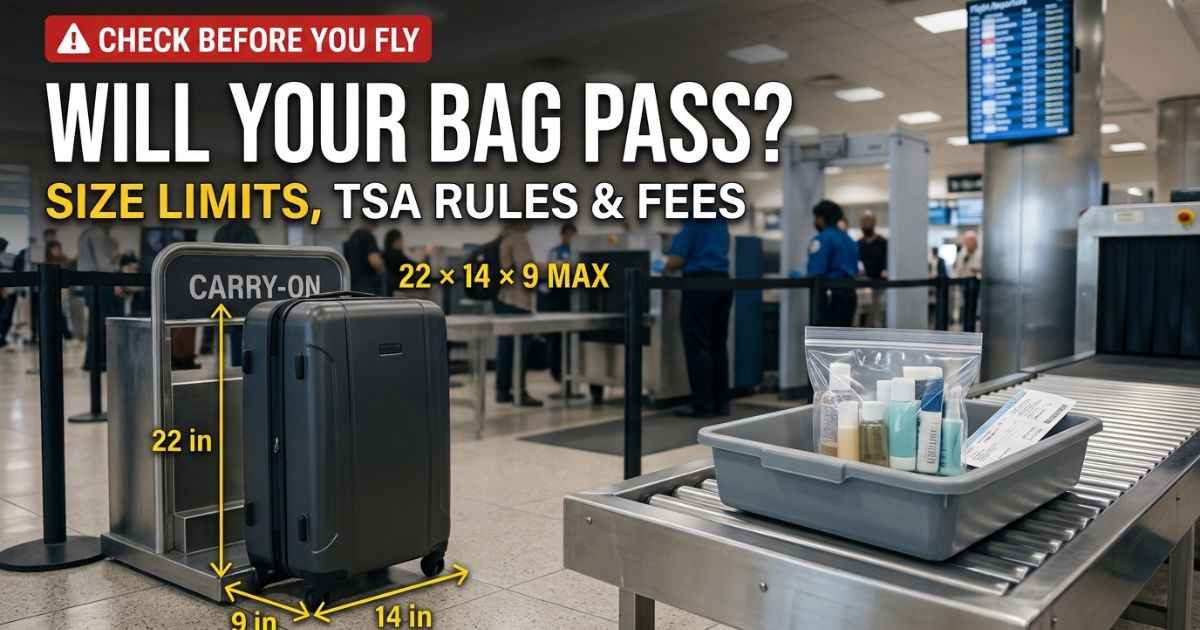
Airplane baggage restrictions come from two places. Your airline sets the size, weight, and fee rules. The TSA sets the security rules, like the liquids limit. The U.S. Department of Transportation says there is no single federal carry-on size, so your airline’s page is the one that counts.
A common U.S. carry-on limit is 22 × 14 × 9 inches. But it is not the same everywhere. Some airlines allow more, and some charge for a full-size carry-on. Read on to see where the rules differ and how to check yours before you pack.
Airplane Baggage Restrictions at a Glance
Think of your trip as three sets of rules.
- Airline allowance: how big and heavy your bags can be, and which ones are included.
- Airline fees: what you pay, which can depend on your fare and perks.
- TSA security rules: what you can bring through the checkpoint.
Keeping these apart clears up a lot of confusion. A bag can meet the TSA rules and still break the airline’s size limit.
Current Checks: Sizes, Weights, and Fees
These details change often. Last updated: November 5, 2026. Always confirm on the airline’s own page before you fly.
| Airline | Carry-on size | Personal item size | Checked bag limit | Checked bag fee (US dollars) |
|---|---|---|---|---|
| American | 22 × 14 × 9 in | 18 × 14 × 8 in | 62 linear inches, 50 lb | Domestic first bag: $50 (US dollars) at the airport, $45 (US dollars) online. Second bag: $60 (US dollars) at the airport, $55 (US dollars) online. These prices apply to tickets issued on or after May 18, 2026. Basic Economy pays $5 (US dollars) more for the first and second bags. |
| Delta | 22 × 14 × 9 in | Must fit under the seat. No size numbers listed on the policy page. | 62 linear inches, 50 lb | $45 (US dollars) first bag, $55 (US dollars) second bag, each way, for applicable travelers |
| JetBlue | 22 × 14 × 9 in | 17 × 13 × 8 in | 62 linear inches, 50 lb | For applicable domestic fares bought over 24 hours before departure. Off-peak: $45 (US dollars) first bag, $59 (US dollars) second bag. Peak travel: $49 (US dollars) first bag, $69 (US dollars) second bag. Fare, membership, travel dates, and purchase time can change these prices. |
| Southwest | 24 × 16 × 10 in | Must fit under the seat. No size numbers listed on the policy page. | 62 linear inches, 50 lb, wheels and handles count | $45 (US dollars) first bag, $55 (US dollars) second bag, each way, on Basic, Choice, and Choice Preferred fares. These prices apply to U.S. mainland tickets booked, ticketed, or changed on or after April 9, 2026. Earlier tickets have different prices. |
| Frontier | 24 × 16 × 10 in, 35 lb. A paid add-on with the basic booking. Included in Economy, Premium, and Business bundles. | 18 × 14 × 8 in, 35 lb | 62 linear inches, 40 lb | Prices change by travel date and purchase time, and are higher at the airport. Use Frontier’s Bag Price Checker. |
We did not check United’s baggage page, so use United’s own site for its current limits. Fees can change by fare, route, and traveler perks. They can also change by how you pay.
Carry-on Baggage Size and Weight Restrictions
A carry-on goes in the overhead bin. Airlines pick the size limit, and the numbers differ. American, Delta, and JetBlue publish 22 × 14 × 9 inches. Southwest and Frontier publish 24 × 16 × 10 inches.
The FAA says several airlines use a top limit of 45 linear inches for carry-on bags. Some airlines use stricter limits. Linear inches means length plus width plus height added together. Your airline’s own numbers always come first.
Your fare matters too. Some airlines include a carry-on. Frontier includes a personal item. A full-size carry-on is a paid add-on with the basic booking. Frontier’s Economy, Premium, and Business bundles include one, and certain Elite members get carry-on benefits. So do not assume every airline gives you a free carry-on.
How to Measure a Carry-on Bag
Several travelers ask if wheels and handles count. At American, they do. Its measurements include handles and wheels.
Follow these steps:
- Pack the bag the way you plan to fly.
- Measure height from the bottom of the wheels to the top of the handle.
- Measure width and depth at the widest points.
- Compare the numbers to your airline’s limit.
Soft bags can bulge when full. Travelers on Reddit ask if a bag that bulges past its stated size will cause trouble. Measure it while it is full, not while it is empty.
Carry-on Weight Limits by Airline
Travel + Leisure reports that several major U.S. airlines do not list a carry-on weight limit. JetBlue lists none as long as you can lift the bag into the overhead bin. Frontier is an exception. It lists a 35-pound limit for its carry-on. Its personal item also has a 35-pound limit.
So the safe plan is simple: check your airline’s page for a weight limit. If there is none, still pack a bag you can lift overhead on your own.
Personal Item Size Restrictions
A personal item is a smaller bag that fits under the seat. A purse, laptop bag, or small backpack can count. There is no one size for all airlines.
- American: 18 × 14 × 8 inches
- Frontier: 18 × 14 × 8 inches
- JetBlue: 17 × 13 × 8 inches
- Delta: must fit under the seat, with no size numbers listed on the policy page
- Southwest: must fit under the seat, with no size numbers listed on the policy page
That one inch can matter. A bag that fits one airline’s limit may be too big for another.
Soft bags are a common question. One traveler asked if a backpack with straps could be a problem. Another asked how often airlines measure personal items. Replies described different experiences, mostly on lower-cost airlines. These are stories, not rules. Do not count on a bag passing just because someone else got away with it.
Checked Baggage Size and Weight Limits
Checked bags go in the hold of the plane. Several airlines use 62 linear inches and 50 pounds as a standard limit. American, Delta, JetBlue, and Southwest publish those numbers. They are common, but not universal.
Frontier’s checked bag limit is 62 linear inches and 40 pounds. That is 10 pounds lighter. Some premium cabins and eligible travelers get higher allowances, so check your ticket.
For international trips, IATA says allowances vary by airline, cabin, aircraft, and route. There is no one rule for all carriers. Look up the limits for your exact flight.
Airline Baggage Fees and Basic Economy Rules
Fees depend on the airline, the fare, and who you are. The Current Checks table above lists the fee examples we have. Here is what to keep in mind.
- Online and airport prices can differ. American lists a lower price online than at the airport. Its prices apply to tickets issued on or after May 18, 2026, and Basic Economy pays $5 (US dollars) more for the first and second bags.
- Your fare matters. Southwest lists its $45 (US dollars) and $55 (US dollars) charges for specific fares, per direction of travel. They apply to U.S. mainland tickets booked, ticketed, or changed on or after April 9, 2026. Choice Extra and some status or card perks can change the charge.
- Timing matters. JetBlue’s prices change during peak travel periods. November 19 to November 30, 2026, falls within its published peak period.
- Extra fees can apply. Southwest lists a separate charge for oversize bags. Frontier lists separate charges for overweight bags. Frontier charges $75 (US dollars) for checked bags weighing 41 to 50 pounds. For bookings made on or after April 4, 2026, bags weighing 51 to 99.99 pounds cost $129 (US dollars). The prices and limits differ, so look up your airline.
Basic Economy causes a lot of confusion. Travelers on Reddit asked if Basic Economy lets them bring both a carry-on and a personal item. That thread is about two years old, so it only shows the question people ask. It does not show the current rule. Check the fare rules on your ticket before you pack.
TSA Carry-on and Checked Baggage Restrictions
The TSA checks what goes through airport security. Its rules cover liquids and items that are banned or limited. They do not set your airline’s size or weight limits.
For a specific item, use the TSA “What Can I Bring?” tool on tsa.gov. We did not check that page for this guide, so use it to confirm anything you are unsure about.
TSA 3-1-1 Liquids Rule
The 3-1-1 rule covers liquids, gels, and aerosols in your carry-on.
- 3: Each container holds 3.4 ounces or less.
- 1: All containers fit in one clear quart-sized bag.
- 1: Each passenger gets one bag.
A traveler asked if TSA PreCheck means skipping the clear bag. TSA PreCheck changes the screening process, not the liquid amounts. Eligible PreCheck passengers do not need to remove their liquids bag during screening. The normal limits still apply: 3.4 ounces or less per container, and one quart-sized bag.
Lithium Batteries and Power Banks
This rule is easy to miss. The FAA says spare lithium batteries and power banks must go in your carry-on bag. They should not go in checked luggage.
There is a gate-check twist. If your carry-on gets checked at the gate, take out the spare batteries and power banks first. Keep them with you in the cabin.
Battery size also matters. The FAA sets these limits:
| Battery size | Rule |
|---|---|
| 0 to 100 Wh | Generally allowed |
| 101 to 160 Wh | Airline approval needed. Two spare batteries per person at most. |
| Over 160 Wh | Not allowed on passenger aircraft |
Wh means watt-hours. It is a number printed on most batteries and power banks.
Firearms, Fireworks, and Other Restricted Items
The TSA travel checklist gives clear rules on two items.
| Item | Carry-on | Checked bag |
|---|---|---|
| Firearms | Not allowed | Allowed only under TSA’s listed conditions |
| Fireworks | Not allowed | Not allowed |
Do not guess with restricted items. Look up the exact item in the TSA tool first.
Oversized, Overweight, and Gate-Checked Bags
A bag can end up in the hold for several reasons. It may be too big for the airline’s limit. The bins may be full. Or you may be on a small plane.
Delta shows how the plane type can matter. On Delta Connection aircraft with 50 seats or fewer, larger carry-ons may be tagged and loaded. They do not go in the cabin. So a bag that meets the usual limit can still be gate-checked.
Travelers on Reddit describe this too. One discussion about a CRJ-900 flight mentions “pink check tags” and boarding delays when bags had to be checked. Another complains about large roller bags filling the bins and bins that would not close.
Here is a short checklist to avoid surprises:
- Measure your bag when it is packed.
- Check your airline’s size limit and any weight limit.
- Look at your plane type on your itinerary. Small planes have less space.
- Keep medicine, valuables, and spare batteries in your personal item.
- Plan for the chance that your carry-on is tagged at the gate.
What if your bag is just a little too big? One Reddit user asked about a suitcase measuring 22.4 × 15.4 × 8.7 inches. One reply said, “Return it and get the correct size. It’s not worth the risk.” Other replies shared different experiences, and none of them prove what an airline will do. The published limit is the only number you can count on.
International Flights and Connecting Airline Baggage Rules
Whether you have one ticket or several changes the rules. Under DOT rules, one ticket with a U.S. start or end point generally follows the baggage allowance set at the start of the trip. For code-share flights, the first marketing airline’s baggage rules generally apply from start to finish.
Separate tickets and some international trips can have different rules. DOT also tells travelers to check aircraft-specific limits and partner airlines.
For these trips:
- Check if all your flights are on one ticket or on separate tickets.
- On separate tickets, look up the baggage rules for every airline.
- Plan around the strictest limit, not the loosest.
- Ask the airline how bags are handled if you switch airlines.
IATA also says allowances vary by route. So do not use a limit from a domestic flight on an international one.
How to Check Your Airline Baggage Allowance Before You Fly
A general chart can help you compare airlines. But it cannot replace the allowance for your own booking. Use this quick process.
- Find your airline. Check which airline operates each flight.
- Check your fare. Basic fares and higher fares can include different bags.
- Open the airline’s baggage page. Find the carry-on, personal item, and checked bag limits.
- Look for perks. Airline credit cards and elite status can change checked-bag fees.
- Check your plane type. Smaller planes can mean gate-checked bags.
- Check TSA rules. Use the TSA tool for any item you are unsure about.
Airplane Baggage Restrictions FAQs
What size can a carry-on bag be?
It depends on the airline. A common limit is 22 × 14 × 9 inches, used by American, Delta, and JetBlue. Southwest and Frontier publish 24 × 16 × 10 inches. Always check your airline’s page.
What is not allowed in a carry-on bag?
TSA does not allow firearms or fireworks in carry-on bags. Liquids must follow the 3-1-1 rule. For any other item, use the TSA “What Can I Bring?” tool.
What is allowed in checked baggage?
Firearms can go in checked bags only under TSA’s listed conditions. Fireworks are not allowed. Spare lithium batteries and power banks should go in your carry-on, not your checked bag.
What is the TSA 3-1-1 liquids rule?
Each liquid container must hold 3.4 ounces or less. All containers must fit in one clear quart-sized bag. Each passenger gets one bag.
Does Basic Economy include a carry-on bag?
It depends on the airline and the fare. Frontier includes a personal item. A full-size carry-on is a paid add-on with its basic booking, but its Economy, Premium, and Business bundles include one. Check the fare rules on your ticket before you pack.
Do wheels and handles count toward carry-on size?
At American, yes. Its measurements include handles and wheels. Measure your packed bag from the bottom of the wheels to the top of the handle.
Does TSA PreCheck remove the 3-1-1 liquids rule?
No. PreCheck changes the screening process, not the liquid amounts. Eligible PreCheck passengers do not need to remove their liquids bag during screening. Each container must still hold 3.4 ounces or less, and all containers must fit in one quart-sized bag.
What are the new airport baggage rules?
Airline baggage rules stay set by each airline. Sizes, weights, and fees can change, so check your airline’s page before each trip. For TSA items, use the TSA item checker instead of lists you see online.
You May Also Like:
Travel Adapter Guide: Plug Types, Voltage, and How to Choose the Right Adapter
How to Get Through Airport Security Faster