
Budget travel tips for beginners start with one rule: add up the full trip cost before you book. One first-time international traveler had booked flights and accommodation for a 21-day Bangkok trip. They were still working out food, transport, and activity costs. This guide shows you how to count every cost first, so a cheap price does not turn into an expensive trip.
Quick answer: List every cost before you book. Include flights, bags, airport rides, a place to sleep, food, local transport, activities, and insurance. Set a daily allowance. Keep a separate buffer for surprises. Compare full prices, not just the lowest fare you see.
Here is the short process:
- Write down every cost you can think of.
- Set a daily allowance and a buffer.
- Compare flights and rooms by total cost.
- Track your spending in a simple way.
Budget Travel Tips for Beginners: Build Your First Trip Budget
Most guides tell you to “set a budget.” Travelers in online discussions say the hard part is knowing what to count. One traveler already had flights and a room. They did not know how to guess meals, rides, tours, and nights out. This section fixes that.
Add every major cost before choosing your destination
Daily costs differ a lot from place to place. Travelers report different costs based on the country, the pace, and the type of room. So no single daily number works for everyone. Add up your own costs instead.
Use this worksheet. Fill in the last column with your own numbers.
| Cost | Type | Your number (write the currency) |
|---|---|---|
| Flights | Fixed | |
| Checked bag and seat fees | Fixed | |
| Airport rides (to and from) | Fixed | |
| Place to sleep | Fixed or per night | |
| Travel insurance | Fixed | |
| Food | Daily | |
| Local transport | Daily | |
| Activities | Daily or fixed | |
| Buffer for surprises | Separate |
Do this before you pick a place. A cheap flight to a costly city can still cost more than a pricier flight to a cheaper one. NerdWallet makes the same point. It tells readers to go where it is cheap, not where it is trendy.
Set a daily budget and keep a separate buffer
Your daily budget covers food, local transport, and activities. Your buffer is extra money for things you did not plan. Keep the two apart. If you mix them, the buffer disappears one coffee at a time.
Use this simple math:
Daily allowance × number of days + fixed costs + buffer = total trip budget
How big should the buffer be? TripZip and Coral Route both suggest a buffer of 10% to 15%. That is their advice, not an official rule. The sources do not give one number that fits every trip. Think about three things:
- How long the trip is.
- How easy it is to change your plans.
- How much risk you are happy to take.
A longer trip with fixed bookings needs more room for surprises. A short trip near home may need less.
Use a spreadsheet, calculator, or simple notes app
Travel Bug Tonic provides a free calculator through its Travel Lab Library. TripZip describes an interactive calculator, but check that its tool works before you rely on it. Online searches also show interest in a travel budget template, calculator, and planner. A free one is fine. Pick the tool you will really use.
One traveler tried notes, a spreadsheet, and a notebook. They stopped tracking after a few days. If that sounds like you, skip the fancy sheet. The tracking section below gives a lighter method.
Cheap Flights for Beginners: Compare the Real Fare
A low fare is only a starting point. The real cost includes bags, seats, and how you get to and from the airport. Several beginner guides tell you to be flexible. Fewer show you how to compare the full price.
Compare flexible dates and nearby airports
Google Flights has tools that help you compare. It has a date grid, a price graph, nearby airport searches, and price tracking. The date grid shows prices across different days. The price graph shows how prices move over time.
Try this:
- Search your route in Google Flights.
- Open the date grid and look at nearby dates.
- Add a nearby airport and compare again.
- Turn on price tracking if you are not ready to book.
Google also lets you explore different places and filter results. This helps if you are open about where to go.
Do not trust a fixed weekday rule
Some guides say to fly on a Tuesday or Wednesday. The official material we reviewed does not prove that. It supports comparing real dates and real prices. Do the same.
The same goes for booking windows. TripZip gives one suggested window. Google’s guidance does not confirm a window that always gives the lowest fare. Treat price tracking as a method, not a magic date.
Check the difference between Best and Cheapest
Google Flights shows both a Best option and a Cheapest option. They trade off different things. Google says the Cheapest option can involve extra steps.
| Possible catch | What it means for you |
|---|---|
| Self-transfer | You move between flights on your own. |
| Separate tickets | Each ticket is its own deal, with its own rules. |
| Bag recheck | You pick up your bags and check them in again. |
| Airport change | You travel between airports to catch the next flight. |
Each one can add work or cost. Google also says its results do not show every offer. So check the airline’s own page before you pay.
Check baggage and optional fees before paying
The US Department of Transportation says airlines must share information about bag fees and other optional services. Read the full fare and the rules before you buy. Bag allowances differ by airline and by fare. Never assume your bag is free.
In one Reddit discussion, a traveler said extra charges made budgeting feel impossible. Another commenter said baggage, seat-selection, and hotel-parking fees can be checked before booking. Both points help you: read the terms, and add the fees to your worksheet.
Budget Accommodation: Compare Hostels, Guesthouses, and Hotels
A hostel is not always the cheapest choice. One traveler reported completing a 24-day trip through eight European cities. They booked several hostels at the last minute. They expected prices of 20 to 30 per night but said several beds cost around 100. The post does not identify the currency. That is one person’s story, not a market average. It does show why you should check prices early.
Compare dorms, private rooms, guesthouses, and hotels
| Type | Good for | Watch out for |
|---|---|---|
| Dorm bed | Lowest price per person in several cases | Less privacy and shared space |
| Private room | More privacy | Can cost more than expected |
| Guesthouse | A local feel and sometimes a kitchen | Rules and extras differ by place |
| Hotel | Comfort and clear terms | Fees and a higher base price |
Coral Route says beginners often overlook guesthouses and similar rooms. Compare all four types for your dates.
Check location, transport, cancellation terms, and fees
A cheap bed far from the center can cost more in rides. Look at the whole picture:
- The total price for your dates.
- How far it is from the places you want to see.
- What it costs to get there each day.
- The cancellation rules.
- Whether there is a kitchen you can use.
Be careful with deals that look too good. The Federal Trade Commission warns about fake travel websites. It also warns about requests to pay with gift cards, cryptocurrency, or wire transfers. Read the terms and check the business before you pay.
Budget Food and Transportation: Reduce Daily Costs
Food and local rides are the costs people forget. They also add up fast. Most guides say “eat like a local” and “use public transport.” Here is how to turn that into numbers.
Mix local meals, groceries, and occasional restaurant visits
Travelers recommend local food, markets, and simple meals. Eating every meal in tourist areas costs more. Cooking at your room helps too. One traveler noted that cooking may not save much on a very short stay, so use it when it fits.
Plan your food allowance like this:
- Pick how many meals you will eat out each day.
- Look up what a local meal costs in your place.
- Add a small amount for snacks and drinks.
- Set the total as your daily food line.
Compare walking, public transport, and local passes
Competitors say to use public transport. They rarely show how to compare it. Try this:
- Find the single fare for a bus or train.
- Count the trips you expect each day.
- Find the price of a local pass, if one exists.
- Pick the lower total.
Walking is free when the distances are short. Check the local bus operator’s timetable and leave extra time before flights or confirmed bookings.
Slow down to reduce unnecessary travel between cities
Slow travel can reduce costs when you visit fewer places over the same period. It can lower transport costs and some attraction fees. Extending the same trip over more days can increase total spending. Savings on tours depend on your activity choices.
Free and Paid Activities: Choose What Matters Most
Not every paid activity is a waste. Not every free one is worth your time. One traveler warned against “16 tourist trap tours in 5 days.” The goal is to choose, not to skip everything.
Pick your paid must-do activities first
Write a short list of the things you most want to do. Put those in your budget first. Then fill in the rest with lower-cost choices. This keeps you from spending on tours you do not care about.
Compare guided tours with self-guided options
| Question | If yes | If no |
|---|---|---|
| Can I do this on my own with a map? | Try it self-guided | Look at a guided option |
| Does it need a guide or special transport? | A paid tour may be worth it | Go on your own |
| Does it fit my must-do list? | Keep it in the budget | Skip it |
NerdWallet suggests free or do-it-yourself sightseeing. Travel Bug Tonic and others also list ways to save on activities. Use them as ideas, then check the details for your place.
Hidden Travel Costs: Baggage Fees, Transfers, and Extra Charges
This is where several trip budgets go wrong. Some optional costs, such as checked bags and seat selection, may appear separately. US airfare prices must include mandatory taxes and carrier surcharges. Short-term lodging prices must include known mandatory fees. This FTC rule took effect on May 12, 2025. Taxes and optional extras may still appear separately.
Check baggage, seats, and payment conditions
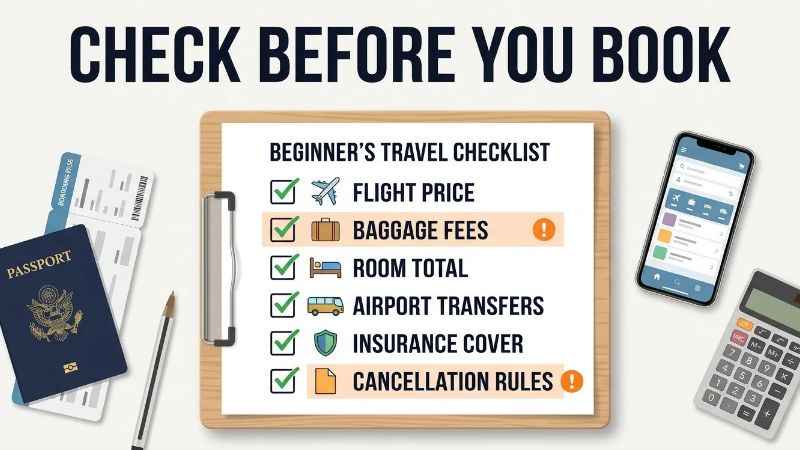
Before you pay for a flight, check this list:
- Is a carry-on bag included?
- What does a checked bag cost?
- Does choosing a seat cost extra?
- What are the change and cancel rules?
- What is the final price at checkout?
The US Department of Transportation explains how airlines must share this information. Use it to compare the final cost of each ticket.
Include transfers, parking, and local arrival costs
A cheap flight can land at an airport far from town. Google warns that cheaper trips can involve airport changes. Add the cost of getting from the airport to your room, and back again. If you drive to your home airport, add parking too.
Compare two flights the full way:
Airfare + optional bag fees + seat selection + airport transfers = total flight-and-airport cost
Do this for each choice. The winner may not be the one with the lowest fare.
Travel Insurance and Booking Safety for Budget Travelers
Saving money should not mean taking big risks. Insurance and careful booking are part of your budget.
Check medical and evacuation coverage
The US Department of State says the US government does not pay medical costs for US citizens traveling abroad. It tells travelers to check their health coverage. It also says to think about travel health and medical evacuation insurance. Medical evacuation means being flown home or to a better hospital for care.
The State Department says evacuation back to the United States can cost 20,000 to 200,000 US dollars. That depends on where you are and your condition. It is a published estimate, not a quote.
Medicare and Medicaid generally do not cover care outside the United States. Know the difference between three types of cover:
- Medical coverage.
- Evacuation coverage.
- Trip cancellation coverage.
Do not assume a basic policy has all three. Read the policy words before you buy.
Check the booking website and payment terms
The FTC gives clear advice for travel deals:
- Check the business before you pay.
- Read the terms.
- Be careful if you are told to pay by gift card, cryptocurrency, or wire transfer.
- Remember that a very low price is not proof that a deal is real.
Track Daily Spending and Stay Within Your Budget
A plan only helps if you can follow it. One traveler said they lost track of a “random snack” and an “iced coffee.” Small buys add up when you do not write them down.
Record purchases without tracking every cent
You do not need a perfect sheet. Try this routine:
- Set one number each morning. Use your daily allowance.
- Note big buys as they happen. A quick note on your phone is enough.
- Check once each night. Add up the day and see if you are above or below.
If you go over one day, spend a little less the next day. Do not dip into your buffer unless you must. Travel Bug Tonic offers a free calculator, TripZip describes an interactive calculator, and Coral Route offers a first-trip money checklist if you want more help.
Current Checks Before You Book
Some facts change often. Check these on the official page before you rely on them.
| Item | What can change | Where to check |
|---|---|---|
| Flight prices | Fares and dates | Google Flights, then the airline |
| Bag rules and fees | Fees and sizes by airline and fare | The airline’s own page |
| Airport ride prices | Train, bus, taxi, shuttle fares | The local transport provider |
| Room prices | Nightly rates, taxes, fees, cancel terms | The booking page |
| Insurance terms | Limits, exclusions, evacuation cover | The policy wording |
| National park fees | Entry prices, fee-free days | The park’s official page |
| Named travel apps | Features, fees, routes | The app’s own site |
National Park Service fee-free days apply to US residents. Other charges, like camping, reservations, and permits, may still apply. Always check the page for the exact park.
Budget Travel FAQs for Beginners
How do I calculate the total cost of a trip?
List every cost before you book. Include flights, bags, airport rides, a place to sleep, food, local transport, activities, insurance, and a buffer. Use the formula in the budget section to add it all up.
How much money should I budget per day?
There is no one number for everyone. Costs change by place, pace, and the type of room. Look up local prices for meals, rides, and activities in your own destination. Then build your daily number from those.
How much extra money should I keep for unexpected costs?
There is no official number. TripZip and Coral Route suggest 10% to 15%, but that is their advice. Base your buffer on how long your trip is, how flexible your plans are, and how much risk you accept. Keep it separate from your daily allowance.
How can I stop small purchases from breaking my budget?
Set a daily number each morning and write down big buys. Check your total once each night. A light routine works better than a complex sheet you stop using.
Are hostels always cheaper than hotels?
No. One traveler reported booking several hostels at the last minute and paying around 100 for several beds, not the 20 to 30 they expected. The post does not identify the currency. Compare dorms, private rooms, guesthouses, and hotels for your dates. Add location and transport costs.
Is flying on Tuesday or Wednesday really cheaper?
Not always. Some guides repeat this advice. Google’s guidance supports comparing real dates and prices with the date grid and price graph. Check your own route.
Is slow travel cheaper than visiting many cities?
It can be when you visit fewer places over the same period. That can lower transport costs and some attraction fees. Extending the same trip over more days can increase total spending. Your own costs may differ.
You May Also Like:
What Does Travel Insurance Cover?
How to Plan a Road Trip: A Simple Step-by-Step Guide