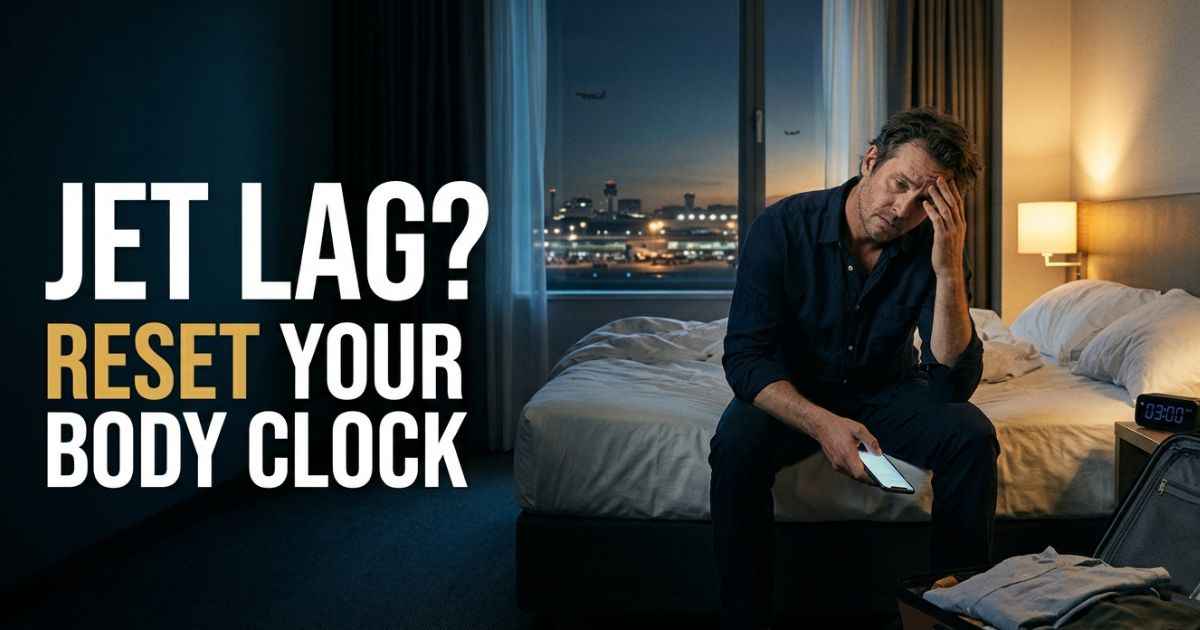
The best jet lag recovery tips all do one thing. They help your body clock match the time at your new place. Follow local sleep and meal times, get light at the right time, and keep naps short. The right time for light depends on whether you flew east or west, and on how many time zones you crossed. This guide gives you simple steps for your first day, your first nights, and the early wake-ups that catch several travelers off guard.
Quick Answer: The Short Version
- Switch to local time as soon as you land if you will stay more than a few days.
- Use light carefully. Light at the wrong time can push your clock the wrong way.
- Keep naps short, about 15 to 30 minutes.
- Eat smaller meals at local meal times.
- Skip extra alcohol, since it can disrupt sleep.
- Do not take more melatonin just because the first dose did not work.
- Expect it to take a few days, and sometimes longer.
What Jet Lag Is and Why It Happens
Your body runs on an inner clock. Doctors call its daily pattern the circadian rhythm. It tells you when to feel sleepy and when to feel awake.
When you fly across time zones, your inner clock stays on home time. The sun and the clocks at your destination say something else. That mismatch is jet lag. The CDC says it commonly shows up when you cross more than three time zones.
Common signs include:
- Trouble falling asleep or staying asleep
- Feeling tired in the daytime
- Poor focus
- Headaches or a general unwell feeling
- Stomach trouble, including nausea
Mayo Clinic says jet lag is temporary. Symptoms usually get better within a few days, though they can last longer.
Jet Lag Recovery Tips for the First 24 Hours
The first day sets the tone. Use this short checklist after you land.
- Change your watch and phone to local time.
- Eat meals at local times.
- Stay awake during local daytime if you can.
- Get outside at the right time for your flight direction (see the next section).
- Keep your plans light.
- Go to bed at local bedtime.
- Set an alarm so you do not oversleep.
Switch to the Destination’s Local Time
Start living on local time right away. Eat when locals eat. Go to bed when it is night there. Set a morning alarm so you do not sleep half the day.
This works best for longer trips. For a trip of two or three days, the NHS says you can keep your usual home sleep and meal times. We cover that choice later.
Get Outside at the Correct Time
Light is the strongest signal for your body clock. The CDC says morning light and evening light move your clock in different ways. Mayo Clinic says morning light helps you adjust to an earlier time zone. Evening light helps you adjust to a later one.
That is why “just get sunlight” is not enough advice. The right timing depends on your direction and on how many time zones you crossed. The next section shows what to do.
Keep Your First Day Manageable
Do not pack your first day with big plans. One traveler on Reddit flew from the US West Coast to Italy. They reported vomiting, a three-hour nap, and a 2 a.m. wake-up. They also felt worried about joining a scheduled tour. That is one person’s story, not medical proof. It does show how rough a heavy first day can feel.
Here is a gentler plan:
- Take a walk outside.
- Eat smaller meals if your stomach feels off.
- Keep sipping water.
- Save big tours and hard tasks for later.
The CDC also suggests arriving at least two days before important events when you can.
Light Exposure After Eastbound vs Westbound Travel
This is the part of jet lag that confuses people most. The goal changes with your direction. The best light timing also changes with the number of time zones you crossed.
| Travel direction | What your clock must do | Light that helps | What to remember |
|---|---|---|---|
| Eastbound | Move earlier | Morning light can help. After 3 to 5 time zones, avoid bright light first thing. Seek mid-morning to late-morning light. | Timing needs care, so avoid light at the wrong hours |
| Westbound | Move later | Evening light can help. Avoid bright light on arrival morning. Seek sunlight in the early afternoon. | Keep daytime activity matched to the new time |
Sources for this table: CDC Yellow Book and Mayo Clinic.
How to Adjust After an Eastbound Flight
When you fly east, you need to fall asleep earlier and wake earlier than your body wants. Your clock must move earlier.
Mayo Clinic says morning light can help with this. The tricky part is that your body may still be on home time when you land. Light at the wrong moment may push your clock the wrong way.
Mayo Clinic says eastbound arrivals who cross 3 to 5 time zones should avoid bright light first thing in the morning. Mid-morning to late-morning light may be more suitable.
Preparing before the flight can help. The CDC suggests moving your bedtime earlier by about one hour a day for two to three days before you leave.
How to Adjust After a Westbound Flight
When you fly west, your clock must move later. You need to stay up later and wake later than your body expects.
Mayo Clinic says evening light can help you adjust to a later time zone. For larger shifts or westward travel, Mayo Clinic also says to avoid bright light on arrival morning and seek sunlight in the early afternoon. Keep your daytime routine matched to the new place. Before the trip, the CDC says you can move bedtime later by about one hour a day.
Why the Wrong Light Can Make Jet Lag Worse
Your clock follows biological time, not the clock on the wall. Your “body night” may not match the night at your destination. Light during your body night can shift your clock in the wrong direction.
The CDC says bright morning light after your clock’s lowest point shifts your clock earlier. That low point comes about 2 to 4 hours before your usual wake time.
The Sleep Foundation also warns that mistimed light can make jet lag worse. The CDC notes that calculators can give timing for your exact trip. These tools plan sleep, light, caffeine, and melatonin around your own schedule. If you cross many time zones, a calculator may be worth a look.
Should You Stay Awake or Take a Nap After Landing?
Almost everyone feels this pull after a long flight. Here is how the advice compares.
| Source | What it says about naps |
|---|---|
| CDC Yellow Book | Short daytime naps of 20 to 30 minutes can help alertness |
| CDC Travelers’ Health | Naps of 15 to 20 minutes may help with sleepiness |
| NHS | Avoid daytime sleep, since it can make night sleep harder |
The sources do not fully agree. So use a simple rule. A short, planned nap can help. A long or late nap can hurt.
When a Short Nap Can Help
If you cannot keep your eyes open, take a short nap. Set a timer for 15 to 30 minutes. One Reddit traveler returning from Hawaii had food poisoning, had been awake for 24 hours, and had major sleep disruption. A commenter suggested a timed nap between 1 p.m. and 3 p.m., but only if the traveler felt better. The commenter also offered staying awake until 9 p.m. as another option. That is personal advice, not medical guidance, but it fits the short-nap idea.
Why Long Afternoon Naps Can Create More Problems
A long nap can steal sleep from your night. The CDC says longer naps can interfere with nighttime sleep. The Reddit traveler in Italy took a three-hour nap around noon. They then woke at 2 a.m. after going to bed at 11 p.m. That is one story, but it matches the warning.
When Staying Awake Until Local Bedtime Makes Sense
Staying awake through the local day helps your body feel sleepy at local night. The CDC says it builds your drive for sleep. This works well if you feel okay. It works less well if you feel very sick or dizzy. If you feel unwell, rest, drink water, and go easy. Do not force yourself through serious symptoms.
What to Do When Jet Lag Wakes You at 3 a.m.
Here is a problem some travelers describe. You land, sleep fine on night one, and feel proud. Then you wake at 3 a.m. on night two, night three, and maybe night four.
A US traveler who flies to Europe often described just this on Reddit. They ate on local time, drank water, exercised, went outside, skipped naps, and kept an 11 p.m. to 8 a.m. schedule. They still woke around 3 a.m. on several nights. Another traveler returning from a trip with a time gap of more than 15 hours reported waking around 3 to 4 a.m. These are personal reports, not clinical proof. They do show how common the problem sounds.
Understand Why Your Body Still Follows Home Time
One good night does not mean your clock has finished moving. After an eastbound flight, 3 a.m. at your destination may match evening at home. Your body may still feel awake because its internal clock has not adjusted.
Keep Bright Light Out of Your Biological Night
If you wake in the night, keep the room dim. Dim light can help you fall back asleep. Do not turn on bright lights.
Local night does not always match your body’s night after travel. The CDC says bright light can shift your clock earlier or later. The effect depends on where your clock is and on your travel schedule. So keep your clock-adjusting light plan tied to your travel direction and the time zones you crossed. The Sleep Foundation and the CDC both stress that light at the wrong time can shift your clock the wrong way.
One Reddit commenter also suggested keeping your phone away during night waking. That is a personal tip, but it fits the dim-light idea.
Keep a Steady Local Wake-Up Time
Pick a local wake-up time and stick to it. The NHS suggests setting an alarm so you do not oversleep. Staying awake through the local day also builds the urge to sleep that night.
Add a short walk outside at the right light time for your flight direction. Keep any nap short, as covered above.
Do Not Try to Fix Everything With Extra Melatonin
Some travelers wonder if more melatonin will stop the early waking. One Reddit traveler took melatonin after a trip with a 15-hour-plus time gap. They still slept only about three hours. They asked if more would help.
A higher dose does not guarantee better body-clock adjustment. Timing matters most, and the CDC warns that the wrong timing can add to the mismatch. The next section explains more.
Does Melatonin Help With Jet Lag?
Melatonin is a hormone your body makes in the dark. It helps tell your body when night has come. Some people take it as a supplement for jet lag.
Mayo Clinic says melatonin may help with sleep during unusual rest times. The NCCIH says research suggests it may help reduce jet lag. The NCCIH also says short-term use appears safe for most people. Still, it is a possible aid. It is not a sure cure.
Why Melatonin Timing Matters
The CDC says melatonin taken at the wrong time can increase the mismatch. The NCCIH says taking it too early in the day can cause sleepiness and slow your adjustment. So when you take it matters as much as whether you take it.
Why Taking More Is Not Automatically Better
Do not raise your amount on your own. A higher dose does not guarantee better body-clock adjustment. Mayo Clinic says some studies found higher doses helped people sleep better. The CDC says 0.5 to 1 mg often produces a clock shift. It advises against doses above 5 mg for that purpose.
The CDC also says supplement amounts can differ from what the label says. The NCCIH lists possible side effects. These include drowsiness, headache, dizziness, and nausea.
Guidance also differs by source. The NHS jet lag page does not routinely recommend melatonin tablets for jet lag. It says the evidence is not strong enough. Check the latest NHS guidance before you rely on this. For help with timing or amount, talk with a healthcare professional.
Who Should Speak With a Healthcare Professional First?
The NCCIH says people with epilepsy should not use melatonin without medical supervision. The same goes for people who take blood thinners. If you have any health condition or take other medicines, ask your doctor first.
What to Eat, Drink, and Avoid While Recovering
Food and drink will not reset your clock by themselves. They can make you feel better while your clock catches up. Healthline says more research is needed on how water and meal size affect jet lag.
| Do this | Why it helps | Skip this | Why |
|---|---|---|---|
| Drink water | The CDC lists it as part of its travel advice | Extra alcohol | It can disrupt sleep |
| Eat smaller meals | The CDC says small meals may ease stomach trouble | Heavy meals at odd hours | They can upset your stomach |
| Caffeine in the daytime | It can lift alertness | Caffeine near bedtime | It can keep you awake |
| Walks and light exercise | They help daytime alertness | Hard exercise in the evening | The CDC says to avoid it then |
Sources: CDC Travelers’ Health, Healthline, and Sleep Health Foundation.
Drink Water and Skip the Extra Alcohol
Water helps you feel better after a dry flight. The CDC also names alcohol as something that disrupts sleep. Poor sleep makes jet lag harder, so keep alcohol low.
Eat Smaller Meals on Local Time
Eat at local meal times to give your body more time cues. Smaller meals may help if your stomach feels unsettled. Simple foods are a good choice on a rough day.
Use Caffeine Carefully
Caffeine can help you stay alert. It does not cure jet lag. The Sleep Health Foundation says it can take about 20 minutes to work and may last up to four hours. So have it in the daytime. Skip it close to local bedtime.
Add Light Activity
A walk outside helps you stay awake and gives you light. The CDC says exercise can help with daytime alertness. A workout alone will not fix jet lag, so keep it simple.
How to Prepare for Jet Lag Before Your Flight
You can start before you leave. A little prep can make landing easier.
Shift Your Sleep Schedule Gradually
The CDC says moving your sleep by about one hour a day for two to three days before you leave may help. Go to bed earlier before an eastbound trip. Go to bed later before a westbound trip.
Get Enough Sleep Before You Leave
Do not start your trip tired. Sleep loss during travel can make jet lag worse, says the CDC. Try to rest well in the days before you go.
On the flight, match your sleep to the night at your destination when you can. The CDC says to cut back on alcohol and caffeine if you want to sleep on the plane. An eye mask and earplugs can make the cabin easier to sleep in. They will not reset your clock alone.
Not everyone can sleep on a plane. One Paris-bound traveler slept about two hours on the flight. They then reported only two to three hours of sleep over 48 hours. If that happens to you, keep the next day simple and follow the local routine.
Decide Whether to Keep Home Time or Switch to Local Time
Match your plan to your trip length.
- Short trip (two or three days): The NHS says you may keep your home sleep and meal times. The Sleep Health Foundation also suggests staying on home time for short trips.
- Longer trip: Switch to local time as soon as you can.
This saves effort. There is little point in moving your whole clock if you will fly home right away.
How Long Does Jet Lag Last?
There is no exact answer. Mayo Clinic and the NHS both say it often improves within a few days. The Sleep Health Foundation says adjusting usually takes at least two or three days. Some people take longer.
Why Recovery Time Varies
Several things change how long it takes:
- How many time zones you crossed
- Which direction you flew
- Your normal sleep habits
- How much sleep you lost while traveling
Some guides use a rough rule of one day per time zone. Healthline gives it as a rule of thumb. Treat it as a guess, not a promise.
Is the Third Day the Hardest?
Not always. Some travelers report bad sleep on nights two, three, or four. But we found no strong medical proof that day three is the worst for everyone. Your own path may look different.
When to Seek Medical Advice
Cleveland Clinic says to contact a healthcare provider if symptoms last or get worse beyond one week. It also lists fever, nausea, vomiting, cough, and sore throat as concerning symptoms. Do not blame vomiting or fever on jet lag by default. Some Reddit commenters on the Italy traveler’s post said vomiting could point to a stomach bug.
Mayo Clinic says healthcare professionals may suggest medicine or light therapy for frequent travelers with big problems. Also get help if you feel very sick, not just tired.
Current Checks
Some advice can change over time. Use this box to recheck before you update this page.
| Item | What to check |
|---|---|
| CDC jet lag advice | Look for a new Yellow Book edition |
| Melatonin guidance | Recheck CDC, Mayo Clinic, NCCIH, and the NHS jet lag page |
| Supplement safety | Recheck NCCIH |
| Jet lag calculators | Confirm any linked tool still works |
| Recovery estimates | Recheck Mayo Clinic and NHS |
Frequently Asked Questions
What is the hardest day of jet lag?
It depends on you. There is no single hardest day for everyone. Symptoms change with the number of time zones you cross, your direction, and your sleep habits. Some travelers report their worst nights on days two to four.
How long does it take to fully recover from jet lag?
Mayo Clinic says symptoms often improve within a few days, though they can last longer. The Sleep Health Foundation says adjusting usually takes at least two or three days. Do not count on a fixed number of days.
Is jet lag worse on day three?
Maybe, but not for everyone. One traveler reported waking at 3 a.m. on nights two, three, and sometimes four. We found no strong medical proof that day three is always worst. Track your own sleep and stick to the local routine.
What are five common symptoms of jet lag?
Five common signs are trouble sleeping, daytime tiredness, poor focus, headaches or a general unwell feeling, and stomach trouble such as nausea. These come from the CDC, Cleveland Clinic, and NHS.
Can a 20-minute nap help with jet lag?
Yes, it can help you stay alert. The CDC gives 20 to 30 minutes as a guide for a short nap. Longer naps can make it harder to sleep at night. The NHS advises against daytime sleep, so use a timer if you nap.
Should I take melatonin if I keep waking up early?
Do not raise the amount on your own. A higher dose does not guarantee better body-clock adjustment. Timing matters, and the wrong time can add to the mismatch, says the CDC. Supplement amounts can also differ from the label. Ask a healthcare professional, especially if you have epilepsy or take blood thinners.
Does traveling east cause worse jet lag than traveling west?
The Sleep Foundation explains that eastward travel can be harder. Flying east means your clock must move earlier. Flying west means it must move later. Plan your light and sleep around your direction.
You May Also Like:
Travel Sleep Tips: How to Rest on Flights and Trips
Airplane Baggage Restrictions: Carry-On, Checked Bags, and TSA Rules