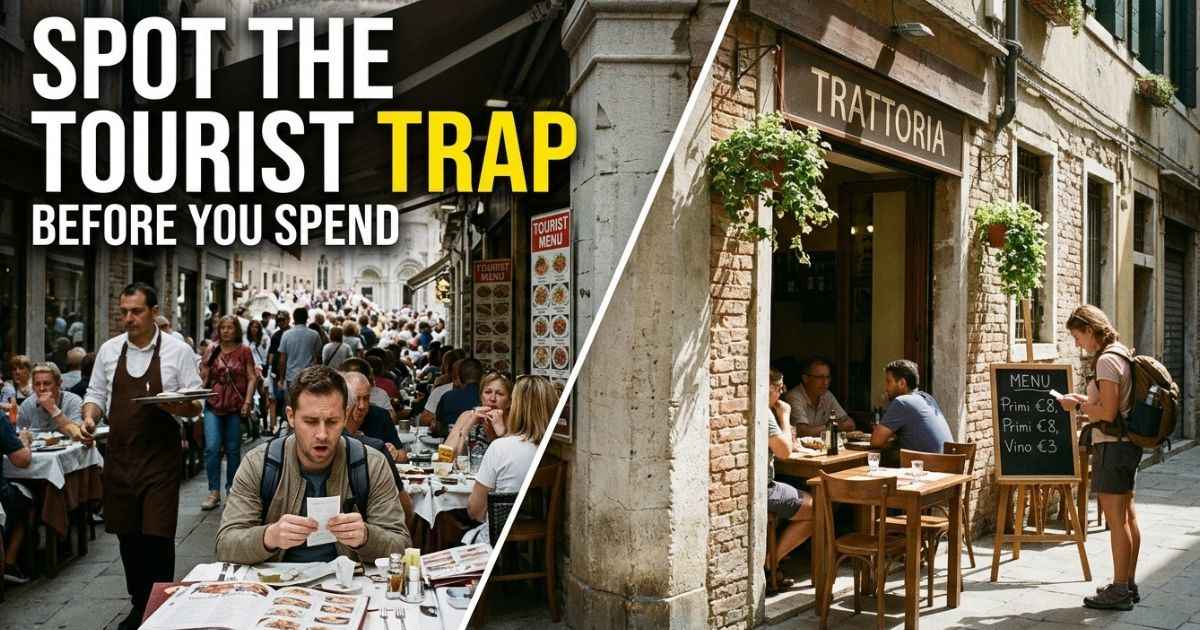
Here is how to avoid tourist traps. Check the full price before you pay. Confirm who is selling your ticket or your ride. Test any local tip before you trust it.
A famous place is not a trap. A trap is a misleading offer, a hidden charge, or a poor-value deal. This guide gives simple checks for food, tickets, taxis, reviews, and street scams. It also shows why some popular warning signs are weaker than they sound.
The short answer: Look at prices before you sit, buy, or ride. Go to the official website for tickets. Use licensed transport. Read recent reviews with care. Ask locals where they eat themselves. Keep visiting famous sights, but be careful with the businesses around them.
How to Avoid Tourist Traps Before You Spend Money
Rushing can leave you less time to check prices, fees, and terms. The FTC advises checking the details before you commit. Slow down for one minute and run these five checks.
Check the Full Price Before Agreeing
Look at food, drinks, service charges, transport fares, and extra fees. Smartraveller is Australia’s government travel advice site. It lists overcharging and wrong change as known travel scams. It also says to check food and drink prices before you order. If a price is not shown, ask first.
Compare More Than One Business
Do not take the first offer. Look at two or three restaurants, tours, or rides. A single quote can look fair until you see another one.
Look for the Official Website
Smartraveller warns that fake websites and profiles can advertise places to stay and event tickets. The U.S. Federal Trade Commission (FTC) also warns about fake sites that copy airlines and hotels. Start with the real website of the attraction or hotel. Type the address yourself instead of clicking a link in a message.
Read Recent Customer Reviews
Recent reviews tell you what a place is like now. A later section shows how to check them.
Check Local Warnings Before You Go
Scams change from place to place. A taxi trick in one city may not exist in another. Before you leave, read the scam warnings for your destination. Smartraveller’s scam page is a good place to start.
How to Spot a Tourist Trap Restaurant
Restaurants are where many travelers feel the pain. The tricky part is that some warning signs are strong and some are weak. This table sorts them.
| Sign | What it may mean | What to check |
|---|---|---|
| No prices on the menu, especially for drinks | Travelers on Reddit list missing prices as a warning sign | Ask the price before you order |
| Staff pulling people in, or handing out flyers | Travelers report this as a common tourist-restaurant habit | Walk past and compare other places |
| A table right beside a big square | Travelers in one r/solotravel thread advise avoiding these spots | Compare prices a few streets away |
| Food you did not order | Smartraveller says restaurants may add unordered items to the bill | Ask before accepting it and read the bill |
| Pictures of every dish | A weak clue only | Check the prices and recent reviews |
| An English menu | A weak clue only | If there are two menus, compare the prices |
| A blackboard menu | Often normal, per one r/AskEurope traveler | Judge by prices and reviews |
Check the Menu Prices Before Sitting Down
Read the menu outside. Look at drinks too. Drinks are where travelers say prices often go missing. If you cannot find a price, that is your answer to ask about.
Watch for Aggressive Restaurant Greeters
Travelers in the r/AskEurope thread list staff who try to talk people in. They also list flyers pushed at passing tourists. Aggressive selling is one clue. It does not prove poor food or dishonest prices. Treat it as a reason to look closer.
Be Careful With Unexpected Food and Drink Charges
Smartraveller says some restaurants and bars bring food you did not ask for and add it to the bill. One travel blogger, Wayward Blog, described a meal in Rome where bread cost an extra 4 euros. The bread was never ordered. That is one writer’s story, not a price rule for Rome. But it shows why you should read the bill line by line.
A commenter in the same r/AskEurope thread also described musicians who walk up to tables uninvited. They then expect a large tip. If that happens, you can say no.
Compare the Menu With Recent Customer Photos
Some review platforms show photos that customers submit. Compare them with the menu. Do the plates look like the food you expected? Do the prices in the photos match what is posted? Check the photo dates and the upload rules. Do not treat every photo as proof of current food quality or portion size. Wayward Blog also suggests checking customer photos.
Check Whether the Prices Match the Location
A seat beside a famous landmark often costs more. That alone does not make a place bad. It becomes a problem when the price is high and the food or service is poor. Another r/AskEurope traveler made this point. A restaurant for tourists is not always a trap. A trap is high prices plus poor quality or misleading charges.
Are Picture Menus and English Menus Always Bad Signs?
No. Some places use picture menus as normal practice. One r/solotravel commenter said a menu in two languages is not strange by itself. The better step is to compare prices if the restaurant has separate menus for different guests.
How to Verify Tours, Attraction Tickets, and Travel Deals
Fake tickets and fake deals are a real part of the tourist-trap problem. They can cost more than one bad lunch.
Start With the Attraction’s Official Website
Go to the attraction’s own site first. See what it sells and at what price. Then compare any other seller to it. Smartraveller lists fake ticket offers as a travel scam.
Check Whether a Reseller Is Authorized
An authorized reseller is a seller that the attraction allows to sell its tickets. Resale can be legitimate in some places. The official website is the best way to learn who counts as authorized.
Skip-the-line tickets need extra care. These tickets promise to let you avoid the regular line. The opening post in the r/EuropeTravelHacks thread listed them as a possible trap when they do not save time. Check what the ticket really includes before you buy.
Read the Cancellation and Refund Terms
Read the rules before you pay. Know what happens if your plans change or the tour does not run.
Compare the Total Price
Add up the full cost, including fees. A low first price can grow at checkout. Compare the final total with the official price.
Avoid Suspicious Discounts and Payment Requests
The FTC lists several warning signs:
- A free vacation offer that asks you to pay
- A travel package with an extremely low price
- A website that copies an airline or hotel
- A request for an unsafe way to pay, such as a wire transfer, gift card, payment app, or cryptocurrency
The FTC also suggests searching the company name with words like “scam,” “review,” and “complaint.” In June 2026, the FTC added two more warnings. Scammers may use paid search ads that show their own phone numbers beside the names of well-known airlines or hotels. They may also link to fake websites that look like real company websites. Fake unpaid toll messages may also target people on road trips. In both cases, go to the real company’s website or the state toll authority yourself.
Some scam messages use phishing. Phishing means a message that tricks you into giving up money or personal details. Smartraveller also warns that fake QR codes can collect financial or personal information.
Be Careful With Tours Sold on the Street
Bea Adventurous, a travel blog, says tours sold on the street are not always bad. It recommends that you pause, walk away, and check the company, the reviews, the price, the group size, and what the tour includes. Avoid rushed decisions. Smartraveller adds that some drivers offer cheap tours, then take visitors to shops where the driver earns a commission. Fleewinter, another travel site, suggests choosing guides with care. It also likes small groups and private tours.
How to Avoid Taxi Scams and Overpriced Transportation
Taxis and airport transfers can add unexpected costs. Check the fare before you travel. Plan this part before you land.
Use Licensed Taxi Providers
Smartraveller says unlicensed taxi drivers may charge visitors more than normal metered fares. The U.S. Department of State gives similar advice. It tells travelers to choose licensed and reputable transport companies. It also says to avoid taxis that do not show company identification and a license.
Check Local Taxi Rules and Use the Meter
Check the local taxi rules first. Use the meter where local law requires one. Smartraveller says not using the meter is illegal in most countries. Some drivers use this trick to overcharge tourists. Agree on a fixed fare only where local rules allow it. Latitude’s travel guide lists a broken taxi meter as the first common trap. Watch for it.
Research Airport Transportation Before Arrival
The State Department suggests that you arrange airport transport before you arrive. It also says to research taxi and rideshare companies ahead of time. Some tracking apps follow your trip. Rideshare coverage and local rules differ from place to place, so check what works in your destination.
The opening post in the r/EuropeTravelHacks thread also listed costly airport-to-city transport as a possible trap. It named hop-on hop-off buses that cost more than public transit. These are the poster’s examples, not proof for every city. Compare the plain bus or train to the tourist option before you buy.
Photograph Rental Vehicle Damage
Smartraveller says some rental operators claim that tourists caused damage that was already there. Take photos of every scratch before you drive away. Never leave your passport as a deposit. Smartraveller notes that some operators ask for passports during damage disputes.
Check the Fare Before You Get In, Then Review the Final Meter Total
Ask about the fare before you get in, where local rules allow it. At the end, compare the total to the meter. Do not accept extra charges you did not agree to.
How to Find Local Restaurants and Experiences Without Tourist Traps
You can find better places. The key is to test each tip instead of trusting it blindly.
Ask Where People Personally Eat
The person who asked the question on Travel Stack Exchange makes a smart point. Some locals suggest places where they think tourists will feel comfortable. These may not be their own favorites. So ask a better question: “Where do you usually eat?”
Ask people who do not earn money from sending you somewhere. Trusted hotel staff were suggested in one Travel Stack Exchange thread. Then check the answer against recent reviews.
Check Nearby Neighborhoods
Move away from the busiest tourist street. A traveler in the 2026 r/travelplanning thread said the right distance changes by city. So do not rely on a fixed number of blocks. Just look for places where residents seem to eat.
Use Local Food Blogs and Local Reviews
Travel Stack Exchange answers suggest local food blogs and reviews in the local language. Google Translate can help you read them. Learning a few food words also helps if you do not speak the language.
Compare Local Tips With Recent Reviews
A local tip plus good recent reviews is stronger than either one alone. If they disagree, look closer before you go.
Check Safety Before Exploring an Unfamiliar Area
In r/travelplanning, the original poster said they were working on a project for solo and budget travelers. They asked whether people had avoided places because they felt unsafe going alone. Start with local safety information. Use trusted transport. Do not accept unasked-for rides. Getting off the beaten path should not mean taking big risks.
How to Check Online Reviews Before Booking
A high star rating does not prove a place is good. The FTC says fake reviews are a real consumer problem. It also says fake reviews can be negative as well as positive. Some travelers in the r/AskEurope thread say they do not trust online reviews at all. A better move is to check them well.
Check the Dates of Recent Reviews
Old reviews may not match today’s prices or service. Look for reviews from the last few months.
Look for Repeated Complaints
One bad review can be a bad day. The same complaint several times is a pattern. Watch for repeated notes about surprise charges or pushy staff.
Compare Multiple Review Websites
The FTC suggests using several sources. Competing guides name Tripadvisor and Yelp as common places to check. Look at more than one site.
Check the Reviewer’s Other Contributions
Click the reviewer’s profile. See what else they have reviewed. A profile that seems made only to post one review deserves a closer look. One review alone does not prove dishonesty.
Do Not Trust a Star Rating Alone
Watch for a burst of reviews in a short time. The FTC lists this as a warning sign. Also think about whether the reviewer got a reward for writing it.
How to Avoid Souvenir, Currency, and Street Scams
These small traps add up. They are also easy to miss when you are busy taking photos.
Check the Price Before Accepting a Service
If someone offers help, ask the price first. Do this before you take a bag, a photo, or a guide. Latitude’s guide lists “suspiciously helpful” bag handlers as a common trap.
Compare Currency Exchange Rates
The opening post in the r/EuropeTravelHacks thread listed airport currency exchange as a possible money trap. Smartraveller adds that wrong change is a known scam. Count your change every time. Compare rates before you swap cash.
Be Careful With Unrequested Gifts
Latitude names the “free trinket routine” and the “guilt trip” as common tricks. Someone hands you a small gift, then asks for money. You can say no and walk on.
Watch Your Belongings in Crowded Places
Smartraveller says pickpockets may use distractions in crowded tourist areas. Latitude also warns about fake police officers. Keep your bag closed and in front of you. If someone claims to be an officer, be careful and slow things down.
Check Whether a Souvenir Is Really Locally Made
CPI Hotels used Karlova Street in Prague as an example of overpriced souvenir shopping. That is one hotel’s view, not a rule. Compare prices at a few shops. Ask where an item was made before you buy.
Should You Avoid Popular Tourist Attractions?
No. One poster in a 2024 r/solotravel thread pushed back on this idea. That poster argued that famous places such as the Eiffel Tower or the Taj Mahal can still be worth your time. This is one traveler’s view, not a proven consensus. The trap is often the stuff around them, not the sight itself.
When a Famous Attraction Is Worth the Price
Ask four quick questions:
- Is the price clear and official?
- Is the seller the attraction itself, or an approved one?
- Does the wait match what you get?
- Am I paying for the sight, or for add-ons I do not need?
A queue can be a clue. DutchNews reported on February 2, 2024, that the Van Wonderen shop in Amsterdam sold stroopwafels for 10 to 13 euros. A market stall called Rudi’s charged 2.50 euros at the time. The report also mentioned queue management at Van Wonderen. These are February 2024 prices, not current prices. Whether a price and a wait are worth it is a value choice, and only you can decide.
How to Avoid Overpriced Services Around Major Landmarks
Plan food and rides before you arrive. Eat a few streets away if you can. Use the official ticket page. This keeps the landmark and avoids the markup.
When to Visit to Reduce Crowds
Bea Adventurous and Fleewinter both suggest going early or late. JayWay Travel adds a bigger idea. It compares Dubrovnik with Korčula in Croatia and suggests looking beyond the most hyped stops. You can do both: see the big sight, then explore a quieter place.
Current Checks Before You Go
Some facts change fast. This guide gives no fixed prices, fares, or rates on purpose. Check these items yourself close to your trip.
| What to check | Why it changes | Where to look |
|---|---|---|
| Attraction ticket prices | Attractions can change prices and fees | The attraction’s official website |
| Timed-entry rules | Entry systems can change | The attraction’s official website |
| Opening hours | Seasons and closures change hours | The attraction’s official website |
| Taxi fares and licensing | Rules vary by place | Local transport rules and the U.S. Department of State |
| Rideshare availability | Coverage differs by city | The ride company’s own app or site |
| Currency exchange rates | Rates change all the time | A current rate on the day you swap |
| Tour operator approval | Approved sellers can change | The attraction’s official website |
| Restaurant menus and prices | Businesses change them | The restaurant’s menu on the day |
| Scam warnings | New tricks appear | Smartraveller and the FTC |
At the time of writing, Smartraveller’s scam page was last updated August 19, 2026. The FTC’s June 2026 travel-scam alert is covered above. A separate FTC alert from September 3, 2026 warns that scammers cover real parking QR codes with fake ones. Check the web address before you pay.
Frequently Asked Questions About How to Avoid Tourist Traps
What are the most common signs of a tourist trap?
Common signs include missing prices, staff pulling people in, and surprise items on the bill. Others are unlicensed taxis and tickets from unclear sellers. One sign alone is not proof. Look for several signs together.
Are restaurants with picture menus always tourist traps?
No. Some places use picture menus as normal practice. Treat photos as one small clue. Check the prices and recent reviews before you decide.
How can you find restaurants that locals actually use?
Ask people where they personally eat. Then check recent reviews and local food blogs. You can also watch where residents sit down, and try a nearby neighborhood instead of the main tourist street.
Should you avoid restaurants near popular attractions?
Not always. Prices there are often higher, but that does not make a place bad. Check the menu prices first. Compare them with places a few streets away.
How can you avoid tourist traps when you do not speak the local language?
Travel Stack Exchange answers suggest asking trusted hotel staff for ideas. You can also read local-language reviews with a tool such as Google Translate. Learning a few food words helps too.
Are skip-the-line attraction tickets always worth buying?
Not always. The opening post in a Reddit thread listed these tickets as a possible trap when they do not save time. Check the official website to see what the ticket includes. Then compare the total price.
How can solo travelers avoid unsafe tourist areas?
Look up local safety information before you go. Use licensed and reputable transport. Avoid rides that no one asked for. Plan your route when you are in an unfamiliar area.
Are famous tourist attractions worth visiting?
Often yes. A busy sight is not the same as a scam. The better plan is to buy tickets from the official source and be careful with the shops, food, and rides nearby.
You May Also Like:
How to Find Cheap Flights Last Minute
Budget Travel Tips for Beginners: Plan Your First Trip Without Overspending