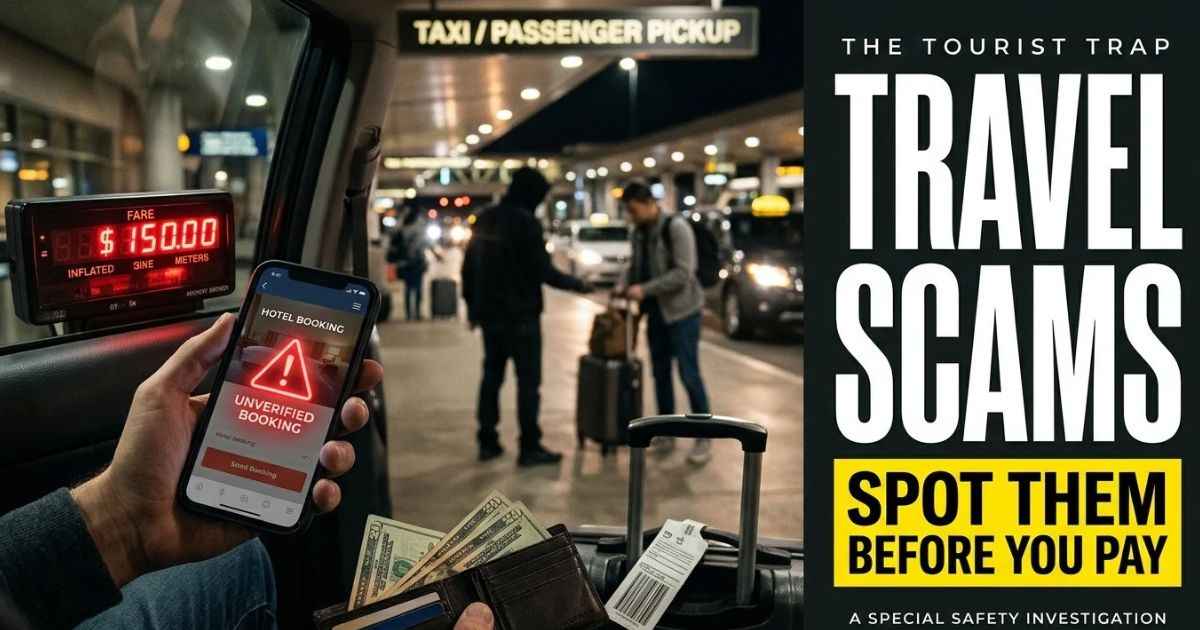
Common travel scams include fake booking websites, taxi fare tricks, street distractions, inflated bills, and card skimmers. They can find you before you leave home, at the airport, or at dinner. The best defense is to know the warning signs before you pay. Scam tactics also differ by destination, so check the place you are visiting.
One setup is worth knowing first. Travelers in Paris and Madrid reported strangers who claimed a bus had stopped or pointed them away from the official taxi line. This guide covers that trick and the rest, plus what to do if you lose money.
What Are the Most Common Travel Scams?
Travel scams happen at five points: while booking, in transit, on the street, when you pay, and after something goes wrong. The FTC, Rick Steves, Wikivoyage, and Harvard all describe scams from several of these groups.
We did not find official data that ranks travel scams from most to least common. So this guide groups them by where you meet them instead of giving a ranked list.
| Scam type | Main warning sign | First response |
|---|---|---|
| Fake booking website | Odd web address or strange payment request | Check the company on its official website |
| Vacation rental scam | Host asks you to pay outside the booking platform | Keep messages and payment on the recognized platform |
| Taxi scam | Driver changes the fare or route | Confirm the fare and destination before you start |
| Distraction theft | A stranger creates a sudden distraction | Keep hold of your bag, phone, and wallet |
| Bar or restaurant scam | Unclear prices or surprise charges | Check the menu and agree on prices first |
| ATM skimming | Card reader looks damaged or altered | Skip that machine and find another |
Common Travel Booking Scams
Several travel scams begin online. The FTC says scam websites can copy real travel companies. Pressure to book right now is another warning sign. A major warning sign is a seller who insists these are the only ways to pay. The methods named by the FTC include wire transfers, gift cards, payment apps, and cryptocurrency.
Fake Travel Websites and Sponsored Ads
A June 2026 FTC alert covers fake airline and hotel ads, misleading sponsored search results, and fake texts about unpaid tolls. A top search result or an ad does not prove a seller is real.
The FTC suggests using a website address or phone number you already know. Do not rely on links or numbers in an ad or text message.
Vacation Rental and Fake Accommodation Scams
The FTC warns that a rental listing may show a property the advertiser does not control. The FTC also suggests checking a property’s address and company name across other listings. Different owners advertising the same address can point to a fake listing.
The BBB recommends reverse-image searching property photos and checking detailed customer reviews. New listings with little feedback need additional verification.
Be extra careful if a host asks you to leave the booking platform and pay directly. Book through the recognized platform, and check the property photos and reviews.
Free Vacation Offers and Fake Travel Agents
The FTC says a “free” vacation may still ask for fees. It also lists vacation robocalls, charter flight scams, and timeshare resale scams. Regions Bank points to pressure to pay quickly as a red flag.
Ask for the total cost in writing before you pay anything. If the seller will not give it, walk away.
Fake Visa and International Driving Permit Websites
The FTC warns about websites that charge for travel documents they cannot issue. It also says fake visa and passport websites may copy official government sites. Some charge fees for services available free through the State Department.
In the United States, AAA and the American Automobile Touring Alliance (AATA) are the groups allowed to issue International Driving Permits. The State Department also says to check driving rules before you travel.
An International Driving Permit is a travel document some countries ask for when you drive. Check the latest rules with official sources before you apply.
Common Taxi and Airport Transportation Scams
Taxi problems come up in several travel guides, including Harvard, Wikivoyage, and Smartraveller. Traveler reports add some newer twists. These are personal accounts, so they show what can happen, not how often it happens.
Broken Taxi Meters and Fare Changes
Harvard lists broken taxi meters as a common scam. A fare agreed in advance is different from a driver changing the price during or after the ride.
One traveler in Istanbul reported that a driver quoted a fare, then a second driver took over. The second driver challenged the traveler’s cash, and the traveler suspected money was taken. Harvard recommends using taxis with working meters or agreeing on prices before departure. The Istanbul traveler reported that their family usually bargained beforehand.
Not every high fare is a scam. A fee that was disclosed up front may be legitimate. The warning sign is a changed agreement or a false claim.
The Fake Airport Taxi Helper
A traveler in Paris described people wearing badges who seemed to guide passengers away from the official taxi line. The same account mentioned a false story about a transport disruption and a fake meter app.
If someone approaches you inside an airport, go to the official taxi line or use a recognized ride service. A badge alone does not prove someone works for the airport.
The Attraction or Bus Is Closed Scam
In Madrid, a traveler was told the airport bus had stopped running and was offered other transport. One commenter described the tactic as raising your worry and then offering a fix.
Northeastern University also lists fake attraction closures. Check the official bus, train, or attraction website yourself before you accept a stranger’s claim.
Taxi Detours and Commission-Based Shops
Wikivoyage and Two Passports Packed describe commission-based shop stops. Northeastern separately warns about drivers taking passengers to friends’ or relatives’ stores, where purchases may be pressured. Say no to extra stops.
A traveler in Thailand reported a tuk-tuk ride that went past the hostel after another person joined. Another commenter who lives in Thailand said they had never seen that scam. So treat it as one disputed report. Still, if a driver changes the route, ask to stop and get out.
Common Street Scams and Distraction Tricks
Rick Steves, InsureMyTrip, and the State Department describe street scams built on a friendly or sudden approach. The goal is to distract you, pressure you, or get you to pay.
Friendship Bracelets, Found Rings, and Free Gifts
In these tricks, a stranger gives you a “free” item or “finds” a ring near you. Then they ask for money. Say no, keep your hands to yourself, and keep walking.
Spilled Drinks and Distraction Pickpocketing
A staged spill or an unexpected chat can pull your attention away. A second person may take your belongings while you look away. Keep your bag closed and in front of you, and keep your phone and wallet out of easy reach.
Fake Police Officers and Authority Scams
Rick Steves and Northeastern both describe people who pose as police. Do not hand over cash, a wallet, or documents to someone you cannot verify.
The State Department also lists other street setups, including wallet and money drop scams and teahouse and restaurant scams. In its bag-watching scam, a stranger asks you to watch a bag. A fake officer later threatens you over its contents.
Smartraveller describes a separate carry-my-bag scam. A stranger asks you to carry a package across a border. The package may contain illegal items.
Common Restaurant, Bar, and Currency Scams
These scams show up when it is time to pay. The State Department and Harvard both describe restaurant and bar bill problems.
Inflated Restaurant and Nightclub Bills
A traveler in a Turkey discussion warned about drivers who send visitors to a “family restaurant,” where the bill may be much higher. Another traveler described being invited into a nightclub and getting drinks. The bill later came to several hundred US dollars, and a bouncer allegedly blocked the exit.
These are personal reports. They show why you should check prices before you order and avoid places you were pushed into. Smartraveller advises checking food and drink prices before ordering. It also recommends confirming charges for food you did not request.
If a bill looks wrong, ask for an itemized copy. If you feel unsafe, leave and get help from the local authorities.
Currency Exchange and Wrong-Change Scams
Rick Steves describes slow-counting and bill-switching tricks. The Istanbul traveler reported a driver rejecting their cash and suspected money was taken. The State Department separately lists fake currency exchanges in its Pakistan travel advice. That is a country-specific example, not a rule for every place.
A poor exchange rate is not always fraud. Look for tricks like a changed amount, a rushed count, or a claim that your cash is “wrong.” Count your money slowly, and do not hand over your whole wallet.
Strangers Who Ask to Check Your Money
A stranger who asks to look inside your wallet or inspect your cash is a warning sign. This is a common move in fake police scams. Say no, and ask to deal with the matter at a police station or public office.
Common ATM and Card Scams
The FBI explains that criminals can put skimming devices on ATMs, point-of-sale terminals, and fuel pumps. A skimmer is a device that copies card details and PINs. Smartraveller also lists card skimming as a travel risk.
Use this short checklist:
- Look at the card reader. Walk away if it looks loose, damaged, or changed.
- Check for hidden devices around the keypad and card slot.
- Cover the keypad with your hand when you enter your PIN.
- At fuel pumps, the FBI recommends tapping instead of inserting or swiping. Do this when your card and the terminal allow it.
- Check your card activity often during the trip.
Not every outdoor ATM is a danger. For other machines, inspect the reader and cover your PIN.
Common Rental Vehicle and Travel Document Scams
False Damage Claims on Rental Cars and Jet Skis
Wikivoyage, Two Passports Packed, and Smartraveller describe damage claims on rentals. Smartraveller advises you to photograph a rental vehicle before you take it. Take photos or video of every side, and keep them until the rental is closed.
Smartraveller also reports rental operators who demand money for alleged damage and hold passports as collateral. It advises travelers never to leave passports as security deposits.
Fake International Driving Permit Sellers
Before you pay for a permit, confirm the seller is AAA or AATA. These are the groups the FTC names as US-authorized issuers. Then check the latest requirements for your destination through official government sources.
Travel Scam Red Flags to Check Before You Pay
Stop and check if you see any of these:
- A price far below similar offers
- Pressure to pay right now
- Vague details about the property or company
- A seller who insists on gift cards, cryptocurrency, wire transfers, or other hard-to-reverse payments as the only way to pay
- A request to move the booking chat away from the recognized platform
- Contact details that do not match the company’s official website
One red flag does not prove a scam. Several together are a good reason to stop.
What to Do If You Have Been Scammed While Traveling
Move quickly, and write down what happened as soon as you can.
Contact Your Bank or Card Issuer
Call your card issuer right away. Keep receipts, screenshots, messages, and transaction records.
The CFPB says a written billing-error notice generally must reach your credit card issuer within 60 days after the statement with the charge was sent. This guidance covers credit card billing errors. It does not mean every payment can be reversed.
Report the Travel Scam
The CFPB points people to the FTC, the FBI Internet Crime Complaint Center (IC3), state attorneys general, and local law enforcement. The FBI IC3 takes reports of internet-based fraud. Report to the place that fits what happened.
Contact the US Embassy or Consulate if Necessary
Contact the nearest US embassy or consulate if you face a safety problem, lose your travel documents, or need emergency help abroad. Use the official State Department contact pages.
Someone may also claim that a relative has been arrested or hurt abroad and needs money fast. Use a phone number you already know to contact the relative or another family member. The FTC and FBI recommend checking before sending money.
Call Overseas Citizens Services when someone claims to be a US citizen abroad and says the embassy will not help. From the US or Canada, call 888-407-4747. From other locations, call +1 202-501-4444.
Current Checks
These details can change. Check each official source before you rely on it.
| Item | What to check | Where to check |
|---|---|---|
| New booking and airline impersonation tricks | Latest alerts | FTC consumer alerts |
| Visa and International Driving Permit rules | Current requirements and approved issuers | State Department and official government pages |
| State Department Overseas Citizens Services | From the US or Canada, 888-407-4747. From other locations, +1 202-501-4444 | State Department scam guidance and Help Abroad page |
| Reporting channels | FTC, FBI IC3, state attorneys general, local law enforcement | CFPB scam and fraud guidance |
| Credit card dispute steps | The 60-day billing-error notice window | CFPB dispute guidance |
| Country-specific scams | Local scams and travel advice for your destination | State Department country pages |
Common Travel Scams FAQ
What are the top five common travel scams?
No official source we reviewed gives a ranked top five. Five types show up again and again in travel guides. They are taxi overcharging, distraction theft, fake booking offers, bill and cash tricks, and card skimming.
What are the latest travel scams to watch for?
A June 2026 FTC alert covers fake airline and hotel ads, misleading sponsored search results, and fake texts about unpaid tolls. Use a website address or phone number you already know. Do not rely on links in an ad or message.
How can I check a travel booking website?
Start with the company’s official website, and use contact details you already know. The FTC warns that scam sites can copy real companies. Be careful with deals that push you to pay fast or insist you pay only with gift cards, wire transfers, payment apps, or cryptocurrency.
Where can I get an International Driving Permit in the United States?
The FTC says AAA and AATA are the US-authorized issuers. Check the latest rules for your destination through official sources before you apply.
What is the difference between being overcharged and being scammed?
Being overcharged means you paid more than you expected or more than a local would. A scam involves tricks, such as a changed agreement, a false claim, or goods that do not match what was promised. One traveler made this distinction in a discussion. It is a personal view, not a legal rule.
How do I report a travel scam?
You can report to the FTC, the FBI IC3, your state attorney general, or local law enforcement, as the CFPB advises. Also contact your card issuer as soon as you can. If you need help abroad, contact the nearest US embassy or consulate.
Sources: FTC, US Department of State, FBI, CFPB, BBB, Smartraveller, Harvard Global Support Services, Northeastern University Police, Rick Steves, InsureMyTrip, Wikivoyage, Two Passports Packed, Regions Bank, and traveler discussions on Reddit.
You May Also Like:
How to Avoid Tourist Traps: A Practical Travel Guide
How to Find Cheap Flights Last Minute