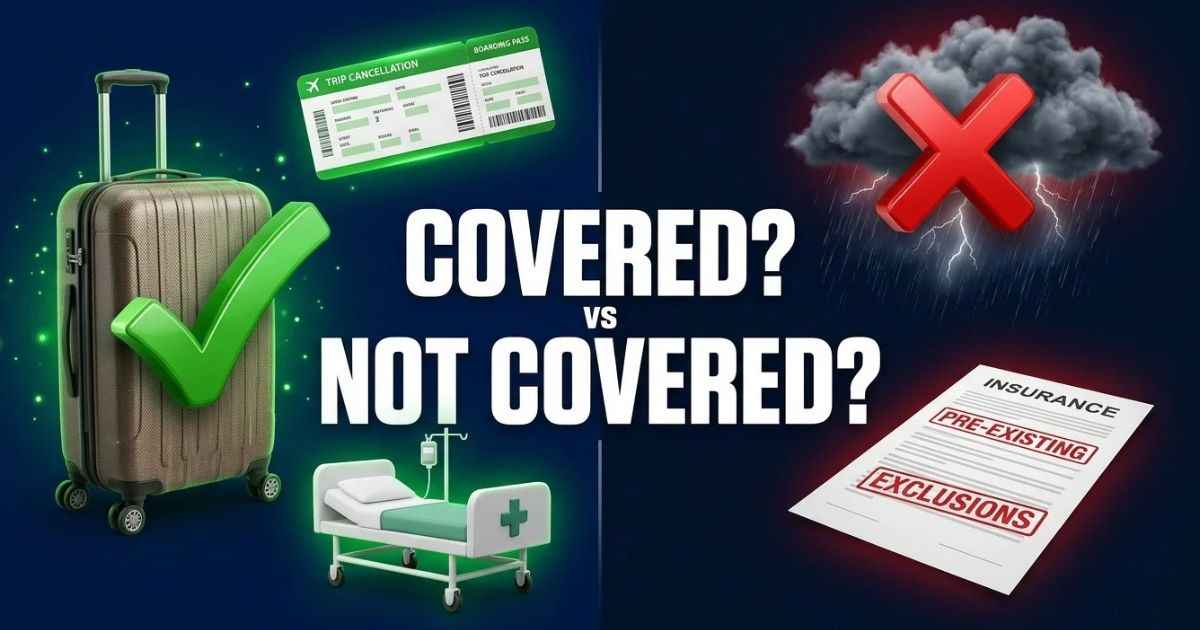
What does travel insurance cover? It can pay back eligible trip costs, medical bills, emergency transport, and lost or delayed bags. But it only pays when the problem fits your policy’s rules. A flight that runs late does not always qualify. A sudden illness may not count if the condition was already there.
Think of a policy as a list of covered reasons, limits, and exclusions. This guide shows what that list usually holds, where claims go wrong, and what to check before you buy.
What Does Travel Insurance Cover?
Most policies mix several types of protection. The table below shows the main ones. Not every policy has every benefit, so check the plan papers.
| Coverage | What it may help pay for |
|---|---|
| Trip cancellation | Eligible prepaid costs when a covered event forces you to cancel |
| Trip interruption | Unused prepaid costs and some extra travel costs |
| Trip delay | Eligible hotel, food, and transport costs |
| Travel medical | Covered emergency medical costs |
| Medical evacuation | Emergency transport to a suitable medical facility |
| Baggage coverage | Eligible losses involving luggage and personal items |
| Missed connection | Extra transport and other qualifying costs |
The National Association of Insurance Commissioners (NAIC) is a group of U.S. state insurance regulators. It says each policy sets its own limits and covered situations. That is the most important idea in this guide.
What is included in a basic plan?
It depends on the plan type. Some plans focus on trip costs. Some add medical care and baggage. Some cover only medical needs.
Read the benefit list, not just the plan name. Two plans with similar names can pay for very different things.
What Does Trip Cancellation, Interruption, and Delay Insurance Cover?
These three benefits sound alike, but they work at different times. One helps before you leave. One helps during the trip. One helps when you are stuck waiting.
What does trip cancellation insurance cover?
Trip cancellation can pay back prepaid, non-refundable costs. This only happens after a covered event makes you cancel. The sources list examples such as illness, injury, a family hospital stay, and severe weather. Natural disasters and some travel company problems can also count.
The key words are “covered event.” The policy must list your reason. If it does not, the claim can fail.
What does trip interruption insurance cover?
Trip interruption applies after your trip has started. It may pay for unused prepaid costs. It may also pay for extra transport, such as a flight home.
Say you must leave early because of a covered emergency. The policy may repay the hotel nights you paid for but could not use.
What does travel delay insurance cover?
Trip delay can pay for extra hotel, food, and transport costs. Most plans want you to wait a set amount of time first. They also cap how much they pay.
Picture a flight canceled by a qualifying storm. You need a hotel room overnight. The policy may repay eligible costs after the waiting time, up to its limit.
Does insurance cover missed flights and connections?
Sometimes. The cause of the problem matters a lot.
One traveler on Reddit used the Chase Ritz-Carlton card’s trip-delay benefit and reported a claim dispute. The delay lasted more than 48 hours in a winter storm. The first delays were due to weather. Later cancellations were listed as a crew issue. The benefit administrator listed weather, equipment problems, strikes, and hijacking as eligible reasons. The traveler said expenses linked to a crew issue were denied.
This is one person’s story. It does not show how often claims are denied. But it shows a real lesson. Your policy looks at the recorded reason for the delay.
What Does Travel Medical Insurance Cover Abroad?
This part matters most for trips outside the United States. The U.S. Department of State says the U.S. government does not pay medical costs for U.S. citizens abroad. It suggests that travelers think about travel health insurance.
The State Department also says Medicare and Medicaid generally do not pay for care outside the country. Trip cancellation insurance usually does not pay for foreign medical bills. So these are different products, and you may need more than one.
Does travel insurance pay for emergency medical treatment?
Travel medical insurance can pay for covered illness and injury costs on a trip. Your usual health plan may not work in another country. Check this before you go.
Berkshire Hathaway Travel Protection (BHTP) explains two terms. With secondary coverage, your other health insurer may pay first. With primary coverage, the travel policy may pay eligible costs first.
Does travel insurance cover emergency medical evacuation?
Medical evacuation insurance can pay for emergency transport to a suitable medical facility. It is not the same as a regular trip home. The State Department says it matters most in places with limited medical care.
The State Department also says an air ambulance trip back to the United States can cost $20,000 to $200,000 (US dollars). The cost depends on location and medical condition.
What is medical repatriation?
Repatriation means getting you back home when it is medically needed. Some policies also help return a person’s remains. Not every plan includes this, so look for it in the benefit list.
Does Medicare cover medical emergencies abroad?
Generally, no. But Medicare.gov lists a few exceptions. One is some care on a cruise ship when the ship is in a U.S. port or no more than six hours away. Rare cases may also qualify for a foreign hospital.
Some Medigap plans may give limited emergency coverage abroad. Medicare.gov says qualifying plans can cover 80% of certain emergency medical charges. A $250 (US dollars) yearly deductible applies. Coverage generally starts within the first 60 days of a trip, with a $50,000 (US dollars) lifetime limit.
So do not assume Medicare never pays. Do not assume it always will, either.
Does travel insurance cover pre-existing conditions?
A pre-existing condition is a medical condition that meets your policy’s definition during its look-back period. The insurer may look at past medical advice, treatment, or other health records. The look-back period differs by plan. Some offer a waiver, which is a special exception with its own rules.
Look for four things:
- How the policy defines a pre-existing condition.
- How far back it looks.
- Whether you must buy the policy within a set time after your first trip payment.
- Whether you must meet other waiver rules.
These rules vary by policy. One insurer’s deadline is not a rule for all insurers.
Does Travel Insurance Cover Lost Baggage, Personal Belongings, and Rental Cars?
This is where many travelers first use their policy. The rules are also strict, so details matter.
What does baggage loss insurance cover?
Baggage coverage can help when bags are lost, stolen, or damaged. Most plans set a total limit. Many also set a limit per item. Check both numbers.
What does baggage delay insurance cover?
Baggage delay can repay the cost of basic items when your bag arrives late. Think clothes and toiletries. Plans often want a wait first. Allstate says this can be 24 hours or more. NerdWallet says six to 24 hours, depending on the plan.
One Reddit traveler said they spent more than $400 on replacement items and got the full amount back. That was one person’s experience. It is not a promise. Keep your receipts and check your plan.
Does travel insurance cover rental car damage?
Some plans add rental car protection. Travelers, an insurer, notes that rental car coverage is not the same as liability coverage. Liability deals with harm you might cause to others. Check which one your plan offers.
Does homeowners or credit card insurance already cover my belongings?
Maybe. The NAIC says baggage insurance is often secondary coverage. It also says some homeowners policies and credit cards may already give some travel or baggage protection. Travelers says homeowners or renters insurance may cover some belongings on a trip.
Check your current policies and card benefits first. You may not need to pay twice for the same protection.
What Does Travel Insurance Not Cover?
This list is where most trouble starts. Knowing it early can save you money and stress.
Known or foreseeable events
Allianz explains that most trip cancellation plans cover specific reasons listed in the policy. An unexpected event does not automatically qualify for reimbursement.
Allianz also shows why timing matters. If you buy a plan after a storm has a name, losses tied to that storm may not be covered. Buy before an event becomes reasonably foreseeable.
Pre-existing conditions without a waiver
Having a condition and qualifying for an exception are two different things.
A Reddit poster planned a honeymoon in Italy. The couple had booked about $7,000 in non-refundable hotels. Then the fiancée faced a possible cancer diagnosis. The poster asked if buying insurance now would protect the bookings. One reply said you can’t buy a policy and then cancel for something you already knew about.
Another poster described a denied claim tied to a parent’s dementia diagnosis. The insurer called it pre-existing. The poster asked how the insurer decided when the condition began, and said they found no clear way to appeal. These are single stories. But they show why you should read the policy’s definitions.
Risky sports and activities
Some plans leave out riskier activities. You may need extra coverage. Seven Corners notes that adventure activities may need an add-on. Check the plan’s activity list before a trip with sports like skydiving.
Alcohol, drugs, and illegal acts
Some policies exclude injuries or losses caused by alcohol or drug use. They may also exclude losses resulting from illegal activities. Check your policy for the exact rules.
Pandemics, war, and civil unrest
The NAIC lists pandemics and civil unrest as common exclusions. But rules differ by insurer. Allianz says some of its plans include an Epidemic Coverage Endorsement. So do not assume every pandemic cost is excluded. Check the plan and any endorsements.
Normal pregnancy and planned medical care
The NAIC lists pregnancy among common exclusions. Seven Corners says complications of pregnancy may be treated differently from a normal pregnancy in some plans. So the details of your policy decide the answer.
Which Optional Travel Insurance Benefits Can You Add?
Optional add-ons cost extra. They can fill gaps that the base plan leaves open.
Cancel For Any Reason coverage
Cancel For Any Reason, or CFAR, lets you cancel for reasons outside the normal covered list. The NAIC says it can give partial repayment. It is usually not a full refund.
The NAIC says CFAR commonly repays 50% to 75%. Plans may require you to insure the full trip cost and cancel at least 48 hours before departure.
CFAR often has a purchase window. NerdWallet describes a typical range of 10 to 21 days for some rules. Windows differ by plan, so check yours.
Interruption For Any Reason coverage
Interruption For Any Reason, or IFAR, works like CFAR but during the trip. It helps if you cut a trip short for a reason the standard plan does not list. Seven Corners describes it as an optional benefit.
Adventure sports coverage
If you plan riskier activities, ask about an add-on. Plans have different lists of covered activities.
Accidental death and dismemberment coverage
NerdWallet lists this as a possible benefit. It adds protection for serious accidents. It is different from regular life insurance.
NerdWallet also lists frequent flyer award reinstatement and quarantine stays as extras on some plans.
How Do You Check a Travel Insurance Policy Before Buying?
A short check can save you from a bad surprise. Use this list.
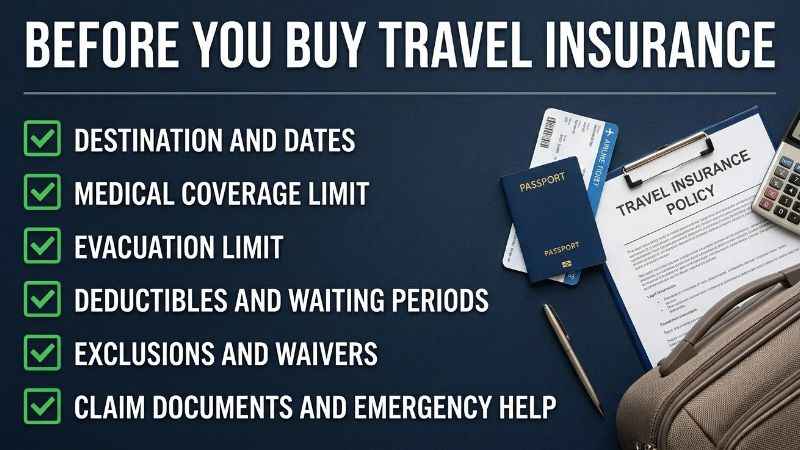
Check your destination and dates
Make sure the plan covers where you are going. Make sure it covers every day of the trip. The State Department also suggests checking trip length.
Compare medical and evacuation limits
Look at the most the plan will pay. Compare plans side by side.
Check deductibles and waiting periods
A deductible is the amount you pay before the insurer pays. Waiting periods can delay baggage or trip delay benefits. Both change what you get back.
Check conditions and activities
Look at how the plan defines pre-existing conditions. Read the exclusions. Check for waiver rules and activity lists.
Read the claim rules
Claims can need a lot of proof. One Reddit commenter complained about the amount of paperwork, including written notes from the airline about a delay and a new flight. Another commenter said all three of their claims over about eight years were paid in full.
Reviews of one insurer on a review site also show both praise and complaints. So keep records as you go. These may include:
- Receipts for extra costs.
- Proof of prepaid, non-refundable costs.
- Airline papers that show a delay or cancellation.
- Medical records or a doctor’s note.
What you need depends on the claim.
Check the emergency help line
Many providers offer 24-hour emergency help. BHTP says this travel assistance is a service, not insurance. It can help in a crisis, but it may not pay your bills. Ask what is included.
Current Checks
These facts can change. Check them before you rely on them.
| Item | What the sources say | Note |
|---|---|---|
| Cost estimate | NAIC: 5% to 10% of trip cost. Progressive: 5% to 6%. Travelers: 3% to 8%. | Progressive’s page is older. Real prices vary by plan, trip, and traveler. |
| CFAR timing | NerdWallet: often 10 to 21 days. | Differs by plan. |
| Waiver timing | BHTP describes a 15-day initial-deposit window for certain benefits. Travelex’s Ultimate plan lists a 21-day window for its pre-existing-condition waiver. | These are examples, not a rule for all insurers. |
| Baggage delay wait | Allstate: 24 hours or more. NerdWallet: six to 24 hours. | Differs by plan. |
| Epidemic coverage | Allianz says some plans have an endorsement. | Check your plan papers. |
| Medicare abroad | General rule is no coverage, with limited exceptions. | Check Medicare.gov. |
Travel Insurance FAQs
What is usually covered in travel insurance?
Most plans cover some mix of trip cancellation, trip interruption, trip delay, emergency medical care, medical evacuation, and baggage loss. Some also cover missed connections. Each plan sets its own limits and rules.
What does travel insurance not cover?
Common exclusions include pre-existing conditions without a waiver, known or foreseeable events, and risky activities. Some plans also exclude pandemics, war, civil unrest, and normal pregnancy. Check the plan wording, since rules differ.
How much does travel insurance cost for a $10,000 trip?
The NAIC says policies often cost 5% to 10% of the trip price. For a $10,000 (US dollars) trip, that is $500 to $1,000 (US dollars). Other sources give lower ranges, so real prices vary.
What are the disadvantages of travel insurance?
The main downsides come from traveler reports. Claims can be denied if the cause does not match the policy. Some claims need a lot of paperwork. Some travelers question the value of travel insurance when coverage rules are unclear or claims require extensive paperwork. One Reddit user abandoned a $500 hotel claim after receiving documentation requests. Reviews also include positive claim stories.
Does travel insurance cover cruises?
Some plans do. Seven Corners covers missed cruises or tours in its guide, and Progressive lists cruise insurance. Medicare may pay for some cruise ship care near a U.S. port. Check your plan for cruise rules.
Does travel insurance cover COVID-19?
It depends on the plan. The NAIC lists pandemics as a common exclusion. Allianz says some of its plans include an Epidemic Coverage Endorsement. Read your policy and any endorsements.
Can I buy travel insurance after booking my trip?
Yes, but timing matters. Coverage may not apply to events you already knew about. CFAR and some waivers also have purchase windows after your first trip payment. Buy early to keep your options open.
Does travel insurance cover flight delays caused by crew issues?
Not always. One traveler using the Chase Ritz-Carlton card’s trip-delay benefit said the benefit listed weather, equipment problems, strikes, and hijacking as eligible reasons. The traveler said expenses linked to a crew issue were denied. Look at the covered reasons in your policy.
The Bottom Line
So, what does travel insurance cover? It can help pay for eligible trip costs, medical care, emergency transport, and belongings. It does this only when the event and your claim meet the policy’s rules.
Before you buy, check three things. Read the covered reasons. Check the exclusions, especially for health conditions. Learn what proof a claim needs. Also look at the cards and policies you already have.
You May Also like:
How to Plan a Road Trip: A Simple Step-by-Step Guide
Solo Travel for Beginners: A Simple Guide to Your First Trip