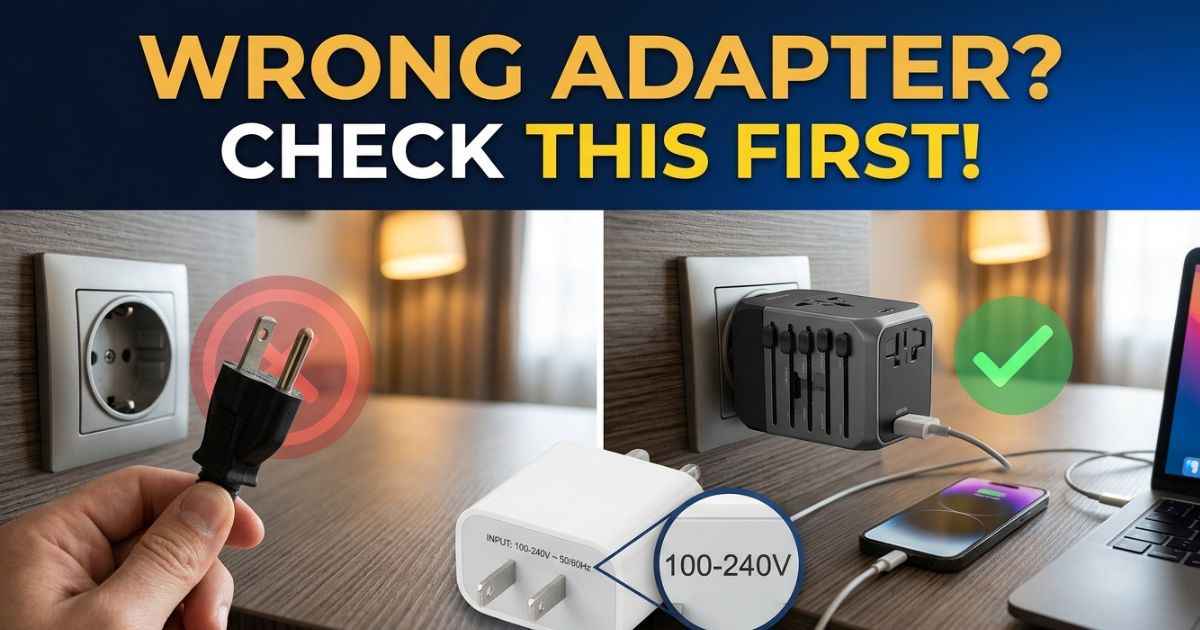
Before you pick an adapter, check two things. First, what shape is the wall socket at your destination? Second, can your device handle the local voltage? This travel adapter guide shows you how to check both in a few minutes.
Here is the key idea. A plug adapter only changes the shape of the plug. It does not change voltage. REI and Electrical Safety First both explain this, and it is the point travelers mix up most often.
| Item | What it does |
|---|---|
| Travel plug adapter | Changes the plug shape so your plug fits the wall socket. |
| Voltage converter | Changes the voltage for devices that cannot handle the local supply. |
| Dual-voltage charger | Accepts a range of voltages, so it often needs only a plug adapter. |
Travel Adapter vs. Voltage Converter: What’s the Difference?
A travel plug adapter is a small piece that sits between your plug and the wall. It lets your plug fit a different socket. Electrical Safety First says an adaptor does not convert voltage or frequency.
A voltage converter does a different job. It changes the electricity itself. You need one only when your device cannot accept the voltage at your destination, as REI explains.
Here is a simple example. You bring a US phone charger to a country with a different socket. You need a plug adapter so it fits the wall. If the charger label shows a wide voltage range, you do not need a converter as well.
One Reddit traveler asked about Peru. They had a “5-in-1” adapter and wondered if it also converts voltage. Having five plug shapes does not mean an adapter changes voltage. Check the adapter’s specs and your device’s label to be sure.
Travel Adapter Types by Country: Which Plug Do You Need?
Plug shapes are named with letters. WorldStandards lists 15 common types, labelled A through O. It says the US Department of Commerce’s International Trade Administration gave the letters.
The table below comes from VDE’s consumer protection guide. VDE is the Association for Electrical, Electronic and Information Technologies. Use the table as a starting point. Sources do not always agree, so confirm the socket where you will stay.
| Destination | Plug types shown | Voltage | Frequency |
|---|---|---|---|
| United States (home) | A, B | 120V | 60Hz |
| Canada | A, B | 120V | 60Hz |
| Mexico | A, B | 127V | 60Hz |
| Japan | A, B | 100V | 50/60Hz |
| India | C, D, M | 230V | 50Hz |
| Brazil | C, N | 127V or 220V | 60Hz |
| South Africa | C, D, M, N | 230V | 50Hz |
| United Kingdom | G | 230V | 50Hz |
Brazil uses both 127V and 220V, depending on location. The Brazilian Ministry of Mines and Energy says 220V is predominant in the Northeast and Central-West regions. Some other areas commonly use 127V.
Frequency is how fast the power cycles each second, measured in hertz (Hz). Electrical Safety First says it can matter for some devices, such as certain clocks. The Japan National Tourism Organization says Japan uses 50Hz in eastern areas and 60Hz in western areas. Nagoya, Kyoto, and Osaka use 60Hz.
Common Plug Types A Through O
You do not need to learn all 15 shapes. Here are the ones that came up most in the guides we reviewed.
| Plug type | Where the guides place it |
|---|---|
| Type C (Europlug) | A common round-pin plug in worldwide guides. |
| Type D | India, Pakistan, Bangladesh, and Nepal, according to Ceptics. |
| Type G | The United Kingdom and several other destinations. |
| Type I | Destinations such as Australia and New Zealand. |
| Type M | South Africa and other destinations in country tables. |
A tip for reading plug guides: some pages have small mistakes. WorldStandards counts 15 types from A to O. One retailer page says “14 plug types” but lists A through O. Another says “12 styles” but lists A through O. Do not rely on one page alone.
Countries That Use More Than One Plug Type
Some countries use several plug types. VDE lists four for South Africa: C, D, M, and N. REI and RS also show more than one type for some destinations.
Sources can also disagree. For Thailand, TESSAN lists Type O. RS lists A, B, C, and O. VDE lists A, B, C, and F. Because of this, ask your hotel or rental host which socket they have.
Will Your US Phone, Laptop, or Camera Work Abroad?
Look at the small print on your charger. Most devices have an input label. It tells you which voltages the device can accept.
Follow these steps:
- Find the label on the charger or the device.
- Look for the word “input.”
- Read the voltage range next to it.
- Compare it with your destination’s voltage.
How to Read a 100-240V Input Label
REI gives an example label that reads “Input 110-240V.” Electrical Safety First shows a similar one, “INPUT: 110-240V.” A 110-240V label covers supplies from 110V to 240V. Japan uses 100V, so check for a 100V rating or ask the manufacturer before plugging in.
A charger marked 100-240V covers Japan’s nominal voltage. You should still check that the frequency works for your device.
When Do You Need a Voltage Converter?
You may need a converter when the label shows only one voltage. This is true if that voltage does not match your destination. A plug adapter cannot fix a voltage mismatch.
| What your label shows | What you likely need |
|---|---|
| A wide range that covers the local voltage | A plug adapter only |
| One voltage that does not match the local voltage | A voltage converter, plus a plug adapter |
Check the device’s voltage and frequency needs. A standard transformer changes voltage, not frequency. Some electronics cannot use voltage converters. Check the maker’s instructions before using one.
If you are unsure, read your device’s manual or ask the maker.
Can You Use Hair Dryers, Curling Irons, and Other High-Wattage Devices Abroad?
These devices use a lot of power. REI and TESSAN both discuss high-wattage devices. The first step is the same as before: read the input label.
REI also gives a simple tip. Check whether your hotel or rental supplies items like a hair dryer. That way you may not need to bring one.
Check the Appliance’s Wattage and the Adapter’s Rating
Watts measure how much power a device uses. Electrical Safety First says to check the maximum wattage or current rating of your adaptor. The adapter must be rated for what you plug into it.
Here is a made-up example to show the idea. Say your hair dryer’s label shows a power number. Your adapter’s label shows a maximum number. The adapter’s number must not be lower than the dryer’s number. These are not real ratings.
Universal vs. Single-Country Travel Adapter: Which Should You Buy?
A universal adapter puts several plug shapes in one product. A single-country adapter fits one kind of socket. RS compares single-region, multi-region, and universal types.
| Adapter type | Main benefit | Main drawback | Best fit |
|---|---|---|---|
| Destination-specific | Usually simpler for one plug type | Less useful for several countries | One-country trips |
| Multi-region | Covers a set of plug types | Coverage depends on the model | Trips with several stops |
| Universal | Several plug shapes in one piece | Can be larger and may not cover every type | Multi-country trips, if the model fits your route |
Real travelers have mixed feelings. In Reddit threads, people called some universal adapters “very bulky” and “bulky and heavy.” Others said some adapters “don’t stay in the outlet very well.” Some commenters prefer small adapters made for one country.
Also, “universal” does not always mean every plug type. WIRED notes that some universal products leave out types such as D, H, or M. Check the exact plug types the product lists.
What to Look for in a Travel Adapter: Safety Checks
A matching plug shape is not enough. VDE says a plug that fits does not prove the device and supply match. Use the checks below before you buy.
- The plug types the adapter supports
- The maximum power rating
- Whether it keeps a grounding connection
- The USB-C output, if you plan to charge a laptop
- The size and weight
Grounding and Protective Earth
Grounding, also called protective earth, is an extra safety path in some plugs. Electrical Safety First says some adaptors do not keep this connection. It advises checking whether your appliance is double-insulated if the adaptor has no earth connection. Double-insulated means the device has extra built-in protection.
One Reddit commenter said they like a tiny ungrounded adapter. That is one person’s choice. Whether you need grounding depends on your device and the adapter.
USB-C Power Delivery and Laptop Charging
USB-C Power Delivery is a way to charge devices, including laptops, through a USB-C port. Travelers on Reddit asked about charging a phone and a MacBook at once. One poster mentioned a 100W need. Another commenter said some USB ports are “quite weak” for fast charging.
Two numbers matter here. One is the adapter’s total power. The other is the power from each single port. Compare your laptop maker’s charging needs with the actual port output of the adapter.
Fuses, Overcurrent Protection, and Safety Marks
Standards exist for travel adaptors. IEC 60884-2-5 covers certain travel adapters rated above 50V and up to 250V, with current up to 20A. It excludes adapters that allow two or more plugs to connect at once. It includes requirements for adapters with built-in overcurrent protection. Check the specific product’s compliance documents before relying on this standard.
Safety marks do not all mean the same thing. In the US, OSHA keeps a list of Nationally Recognized Testing Laboratories. These labs test and certify products. UL and ETL Listed are product certification marks you may see. OSHA lists UL LLC and Intertek Testing Services as Nationally Recognized Testing Laboratories.
The CE mark works differently. The European Commission says the maker does the conformity checks, writes the paperwork, and adds the mark. So CE alone does not show that an outside lab tested the product. No single logo proves an adapter suits every device or country.
Why Does My Travel Adapter Not Fit or Stay in the Outlet?
Some travelers report problems with bulky adapters and loose socket connections. RS says universal adapters can be larger and heavier. It adds that they may block nearby sockets and fit less firmly in loose outlets.
Rick Steves points out another issue in Europe. Some sockets are recessed, meaning they sit deep in the wall. A bulky adapter may not reach, so a small adapter made for that trip can work better.
Try these steps:
- Pick a smaller adapter if you visit only one or two plug types.
- Do not force a plug into a socket.
- Stop using an adapter or cable that looks damaged.
Travel Adapter Pre-Trip Checklist
Run through this list before you leave the US.
- Confirm the plug type at each destination.
- Check the voltage and frequency at each destination.
- Read the input label on each device.
- Check each appliance’s wattage.
- Check the adapter’s maximum rating.
- Find out if your device needs grounding.
- Check the USB-C output if you will charge a laptop.
- Ask about the sockets where you will stay.
- Look for damage on your adapter and cables.
Current Checks
Some facts change over time. Recheck these before each trip.
| What to check | Why it changes |
|---|---|
| Plug types by country | Sources sometimes disagree, as with Thailand. |
| Destination voltage and frequency | Country data can be updated. |
| Plug types an adapter supports | Makers can change a model. |
| USB-C output and total power | Specs differ by model. |
| Adapter maximum power rating | Ratings differ by model. |
| Safety certification | A logo does not show the full scope. Check the maker’s or tester’s record. |
Travel Adapter Guide FAQs
Does a universal travel adapter convert voltage?
No. A plug adapter changes only the plug shape. Electrical Safety First says it does not convert voltage or frequency. Check your device label and the adapter’s specs.
Do I need a travel adapter for Japan?
VDE lists Japan with plug types A and B, the same types it lists for the US. Japan mainly uses Type A outlets. Type B grounded outlets also exist, but they are less common. US travelers with three-prong plugs should check their accommodation before departure.
Japan’s voltage is 100V, while the US is 120V. Still, read your device label and confirm the socket where you will stay.
Can I use a US hair dryer with a travel adapter?
Maybe, but check first. A plug adapter does not change voltage. Read the hair dryer’s label and compare it with the local voltage. REI also suggests checking if your lodging supplies one.
Does a Type D adapter work in India and Pakistan?
Ceptics lists both India and Pakistan as Type D destinations. It also lists Bangladesh and Nepal. VDE shows India with types C, D, and M, so ask about the exact socket where you will stay.
Pakistan uses Type C and Type D sockets, according to the RS country guide, which lists a supply of 230V. Check your accommodation before choosing a single-type adapter.
Can a travel adapter fast-charge a laptop?
It depends on the model. Look at the output of each USB-C port, not just the total power. Compare it with what your laptop maker says the laptop needs.
Why does my universal travel adapter fall out of the socket?
Reddit travelers say some adapters do not stay in the outlet well. RS says universal adapters can be heavier and may fit less firmly in loose outlets. A smaller adapter made for that socket may fit better.
Is a universal travel adapter better than a country-specific one?
It depends on your trip. A universal adapter helps with several countries, but it can be bulky. A country-specific adapter is smaller, but it covers fewer places.
You May Also Like:
How to Get Through Airport Security Faster
How to Deal With Jet Lag: What to Do Before, During, and After a Flight