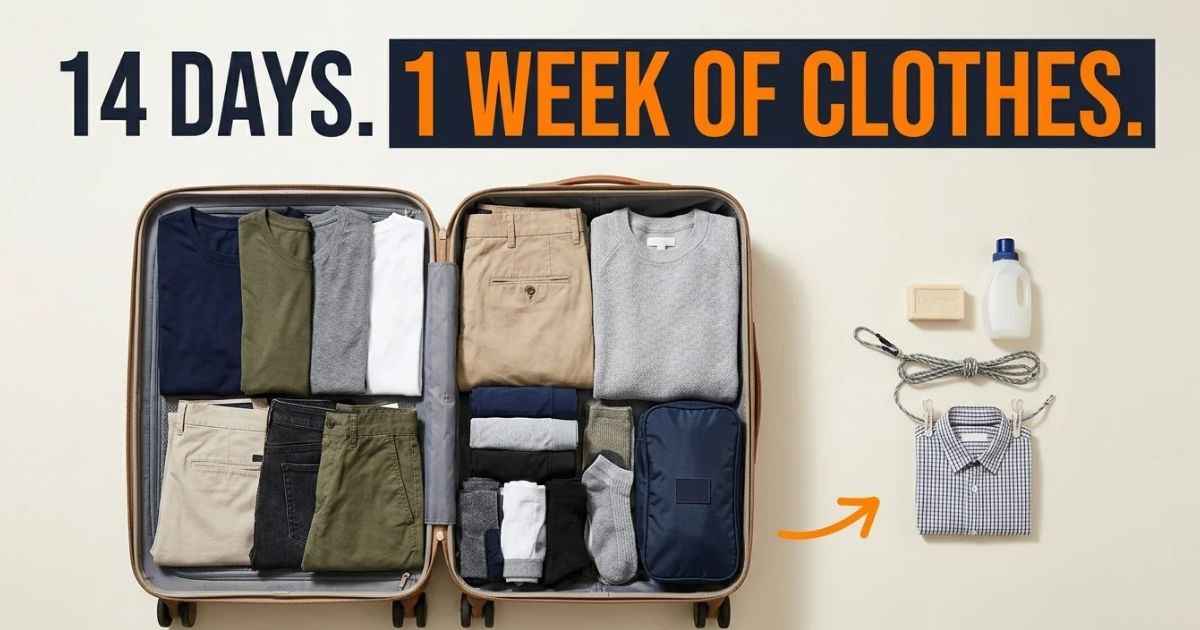
You do not need 14 outfits for 14 days. Pack about one week of clothes, plan to wash once, and choose pieces that mix and match. REI suggests keeping clothes to about seven days’ worth and washing during the trip.
This guide shows you how to pack light for a 2-week trip. You get a starter checklist, a simple laundry plan, and a fresh-clothes option for people who do not want to rewear things. You also get a short list of rules to check before you fly.
How to Pack Light for a 2-Week Trip: Starter Checklist
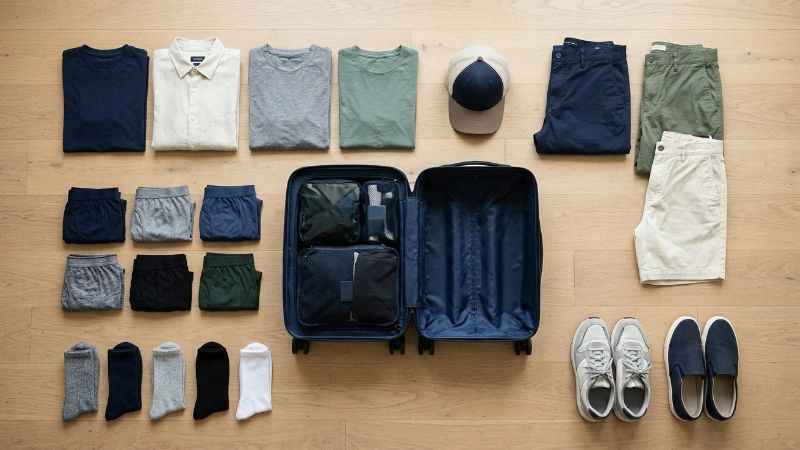
Start with this list, then change it for your trip. It assumes mild to warm weather and a plan to wash clothes at least once. It comes from REI’s 1-2-3-4-5-6 rule, which is a shortcut, not a law. REI says six pairs of underwear get you through six days before laundry. This list uses seven pairs to cover a full week.
| Item | Starter amount | Why it helps |
|---|---|---|
| Hat | 1 | Adds sun cover and takes little space |
| Shoes | 2 pairs | Keeps footwear from taking over your bag |
| Bottoms (pants, skirts, shorts) | 3 | Each pair should work with several tops |
| Tops | 4 | Rewear and wash to cover two weeks |
| Socks | 5 pairs | Choose quick-drying socks if you plan to wash them during the trip |
| Underwear | 7 pairs | Covers a full seven-day stretch before you wash |
Other guides use different formulas. One popular version, the 5-4-3-2-1 rule, calls for five pairs of socks and underwear, four tops, three bottoms, two pairs of shoes, and one jacket. Both are planning shortcuts. Neither one is a standard.
How Many Clothes Do You Need for Two Weeks?
Think in weeks, not days. Pack for about seven days, then wash. That cuts your clothes in half. One traveler on Reddit got the same advice and called it cutting the amount of clothes in half.
Here is how the math works. If you wash once near the middle of the trip, each item only needs to last about a week. Choose clothes that dry fast so the wash does not cost you a day.
One two-week Japan trip shows what a small list can look like. The traveler on Reddit brought two pairs of pants, a skirt, several tops, a merino sweater, and a packable rain jacket. This is one person’s report, not a rule.
What Should Change if You Cannot Do Laundry?
Some travelers do not want to rewear clothes. One traveler on Reddit said they literally never rewear clothing without washing. That is a fair choice, but it changes your packing.
If you want a fresh pair of underwear each day, you need 14 pairs for 14 days. That takes more space. You have three options:
- Pack more underwear and socks, and keep the outer clothes small.
- Plan a mid-trip wash for underwear and socks only.
- Use a bigger bag, if your airline allows it.
Pick the choice that fits your trip. Be honest about what you will really do. A bag that only works if you rewear everything will not work for you.
How to Plan Laundry Before You Pack
Laundry is what makes a light bag possible. Saying “I will do laundry” is not a plan. Pick a day, a method, and a drying spot before you leave.
Here is a simple schedule:
- Pack about seven days of clothes.
- Wear your clothes through the first week.
- Pick a wash day near the middle of the trip.
- Wash the dirty clothes and let them dry while you rest or sightsee.
- Pack up clean clothes and start week two.
Match the wash day to your itinerary. Do not plan it for the night before an early train. Clothes need time to dry. Leave enough time for washed underwear to dry before you need it again.
Sink Washing, Hotel Laundry, or a Laundromat?
Each method has trade-offs. One guide compares four ways to wash clothes on a two-week trip. Here is a simple view.
| Method | Good for | Watch out for |
|---|---|---|
| Sink washing | Small loads, socks, underwear | Drying time, and it takes effort every time |
| Hotel laundry | Easy washing with little work | Cost and turnaround time vary by hotel |
| Laundromat | Washing a full week at once | You need to find one and spend time there |
Sink washing gets tiring. One traveler on Reddit planned to wash shirts every second night on a three-week trip. They could picture themselves at 10 p.m. deciding the shirt was good for one more day. Ask yourself if you will really do it.
Prices and hours change by place. Check your hotel or a local laundromat before you count on either one.
How to Dry Clothes When Traveling
Slow drying is the hidden problem with light packing. Wet clothes in a humid room can stay damp for a long time. Plan for it.
- Gently press out excess water.
- Lay the item on a towel, roll it up, and press the towel to absorb water. REI describes this towel-assisted drying.
- Hang the item in a spot with air moving around it.
- Wash in the morning or afternoon, not late at night.
- Pick quick-drying fabrics when you buy clothes for the trip.
Test your fabrics at home first. Wash a shirt and see how long it takes to dry. Then you know what to expect.
Keep dirty clothes away from clean ones. One traveler on Reddit uses a dedicated dirty-laundry bag or cube and carries a small amount of suitable detergent. Their tip was that separating laundry kept clean clothes from smelling.
How to Build a Mix-and-Match Travel Capsule Wardrobe
A capsule wardrobe is a small set of clothes that all work together. Every top should go with every bottom. That gives you more outfits from fewer items.
Here is why that matters. With four tops and three bottoms, you can make up to 12 combinations. You get variety without extra weight.
Follow these steps:
- Choose colors that work together, so any top goes with any bottom.
- Pick pieces you can dress up or down.
- Add one warm layer you can put on over anything.
- Skip pieces that only go with one outfit.
Several guides suggest merino wool and technical fabrics. They help with repeat wear and quick drying. They are choices, not must-buys. Clothes you already own and like may work just as well.
How to Adjust Your Packing List for Weather and Activities
A list for sunny sightseeing will not work for a cold hike. Check your trip first, then change the list. Look at a reliable local forecast about five to seven days before you leave.
Mixed weather happens on warm trips too. The Japan traveler on Reddit reported mostly 60 to 80°F weather, with one windy mountain day around 45°F. Their packing list included a merino sweater and a packable rain jacket.
| Trip type | What to change |
|---|---|
| Warm | Lighter fabrics, a hat, one thin layer for cool nights |
| Cool | One or two warm layers instead of extra tops |
| Mixed weather | Layers you can add or remove, plus a packable rain jacket |
| Hiking or outdoor days | Shoes that handle trails, and a layer for higher places |
| Dressier events | One outfit that fits the event, and check any dress rules |
Pack for the real weather and your plans. Do not guess how people dress in a place. Confirm any dress rules instead.
Cold trips need more. One seasonal guide lists thermal tops, sweaters, warm pants, a coat, and insulated footwear for winter. That is a good fit for a cold trip, but it is not the default list for every traveler.
How Many Shoes, Toiletries, and Electronics Should You Pack?
Small items take up more room than you think. Shoes are the biggest space problem. REI suggests multipurpose footwear, meaning shoes that work for walking and for dinner.
- Shoes: Wear your bulkiest pair on the plane. Pack one more pair at most.
- Toiletries: REI advises leaving most toiletries at home. Buy basics at your destination if you can.
- Electronics: Bring only what you will use. REI even suggests asking if you really need your laptop.
One traveler on Reddit came home from two weeks in Southeast Asia with a 26-liter bag. They had carried unused clothes and a backup battery the whole trip, and called it a “mini defeat.” Before you leave, ask what each optional item is for.
How to Pack Toiletries for a Carry-On
The U.S. rule covers liquids in your carry-on. Containers must be 3.4 ounces or less, and they must fit in one clear quart-size bag per passenger. This rule is about airport security screening.
That number is a limit on container size. It is not the amount you should bring. A face cream or shampoo may need a much smaller container. REI notes that some essential liquids, including medicines and baby formula, have exceptions to the standard carry-on liquid rules. Check the official TSA guidance before you fly, since rules can change.
Which Electronics and Essentials Should Stay Accessible?
Keep key items where you can reach them. That means documents, medication, and charging gear. Do not bury them at the bottom of your bag. The U.S. Department of Transportation recommends keeping essential items in your carry-on, including toiletries and one change of underwear, in case checked luggage arrives late.
Power banks need extra care. The FAA says spare lithium batteries, including power banks, must go in the cabin and not in checked bags. The limits depend on watt-hours (Wh), which is a number that shows battery size:
- 0 to 100 Wh: generally allowed.
- 101 to 160 Wh: airline approval is required, with a limit of two spare batteries per person. Check your airline for stricter limits.
- Above 160 Wh: not allowed on passenger planes under this guidance.
Look for the Wh number on your battery. Check the current FAA guidance before you travel.
How to Choose a Carry-On That Fits Airline Rules
Bag rules depend on the airline. The U.S. Department of Transportation says there is no single federal standard for carry-on size. You must check each airline and aircraft, including every airline on a trip with more than one.
A personal item is the small bag that goes under the seat. A carry-on is the larger bag that goes in the overhead bin. Several fares treat them differently.
American Airlines is one example. It lists a carry-on limit of 22 x 14 x 9 inches, including wheels and handles. Its personal item limit is 18 x 14 x 8 inches. The airline also says some aircraft or airports may have more limits. These sizes apply to that airline only.
Some guides call 7 kg a typical carry-on weight limit. The DOT says there is no federal standard for size or weight. Do not assume that number fits your flight.
Your own comfort matters too. Rick Steves suggests walking around with your packed bag before you leave. His personal limit is 20 pounds in a 9 x 21 x 14-inch bag. That is his own guideline, not an airline rule. Use it as an idea, not a requirement.
Current checks
These facts can change. Check them before every trip.
| Check | Where to look | Current detail in this guide |
|---|---|---|
| Carry-on and personal item size and weight | Each airline’s website | American Airlines lists 22 x 14 x 9 inches and 18 x 14 x 8 inches |
| Liquids rule | Official TSA guidance | 3.4 ounces or less, in one clear quart-size bag |
| Power bank rules | Current FAA guidance | Spare batteries in the cabin, with Wh limits |
| Laundry hours and costs | Your hotel or a local laundromat | Varies by place |
| Weather | A reliable local forecast | Check five to seven days before you leave |
Are Packing Cubes and Compression Bags Worth It?
They help, but they do different jobs. Packing cubes keep your bag organized. Compression bags squeeze clothes into less space.
| Tool | Helps with | Does not help with |
|---|---|---|
| Packing cubes | Organizing and finding things | Weight |
| Compression bags | Making clothes take up less room | Weight, and clothes may crease |
One guide points out that compression cuts volume but not weight. That matters. If your bag is under the size limit but over the weight limit, a compression bag will not fix it.
Use cubes if you like order. Use compression only if space is your real problem. Neither one replaces taking less.
What If You Cannot Do Laundry or Rewear Clothes?
Some trips offer no easy laundry. Some travelers also have work gear, a hair tool, or personal-care items to carry. One traveler on Reddit wanted to avoid a baggage fee and worried about fitting a laptop, charger, and hair straightener in a budget airline personal item.
Here is a simple way to decide:
| Your situation | What to try |
|---|---|
| You can wash once | Use the starter list and the mid-trip wash plan |
| You will wash small items only | Pack extra socks and underwear, keep outer clothes small |
| You never rewear and cannot wash | Pack a fresh set for each day and plan for a bigger bag |
| You must use a personal item only | Cut duplicates, mix outfits, and check your airline’s limits |
Commenters on Reddit suggested combining outfits, cutting duplicates, and doing small wash loads. You can also pack a second set of work items only if you will really use them. The goal is a bag you can carry, not a perfect list.
Final Check: What to Leave Out
Before you zip your bag, lay everything out. Ask what each item is for. If you cannot name a real use on your itinerary, leave it home.
- Remove extra “just in case” clothes. One Reddit poster kept packing clothes just in case.
- Cut duplicate shoes and bulky layers you may not need.
- Skip items you carried last trip and never used.
- Keep health and safety items when the risk is worth the weight.
Then walk around with your bag. If it feels too heavy now, it will feel worse after hours of travel.
Frequently Asked Questions About Packing Light for Two Weeks
How do you pack light for a 2-week trip?
Pack about seven days of clothes and plan to wash once. Choose clothes that mix and match and dry fast. Check your airline’s bag rules before you start.
How many clothes should you pack for a two-week trip?
REI’s starter formula is one hat, two pairs of shoes, three bottoms, four tops, five pairs of socks, and six pairs of underwear. This guide’s checklist uses seven pairs of underwear to cover a full week. Change the list for weather and activities. Pack more if you cannot wash.
What is the 5-4-3-2-1 packing rule?
It is a packing shortcut with several versions. One guide uses five pairs of socks and underwear, four tops, three bottoms, two pairs of shoes, and one jacket. It is a starting point, not a standard.
How often should you do laundry on a two-week trip?
Several travelers plan one wash near the middle of the trip. Sink washing every few nights can get old fast. Pick a method and a wash day before you leave, and check drying time.
Can you pack for two weeks using only a personal item?
Some travelers try it, but it is hard if you carry work gear or need a fresh outfit each day. Check your airline’s personal item size first. American Airlines lists 18 x 14 x 8 inches for its own policy.
How many pairs of underwear should you pack?
REI’s formula suggests six pairs, which gets you through six days before laundry. For a full seven days, pack seven pairs or plan laundry earlier. If you want a fresh pair each day, you need 14 for 14 days.
Are packing cubes or compression bags worth it?
Cubes help you stay organized. Compression bags cut volume but not weight, and clothes may crease. Use them to solve a space problem, not a weight problem.
What should you leave out of a packing list?
Leave out items you cannot link to a real use on your trip. One traveler came home with unused clothes and a backup battery. Do a final check before you zip the bag.
You May Also Like:
Fun Things to Do Near Me for Teens: Indoor, Outdoor, Free, and Weekend Ideas
Best Things to Do in Boston: A Practical Guide for Every Visitor